We will posting updates and other insights on American Mishima projects and other doings of the author there as well as give our audience an additional level of interaction with us.
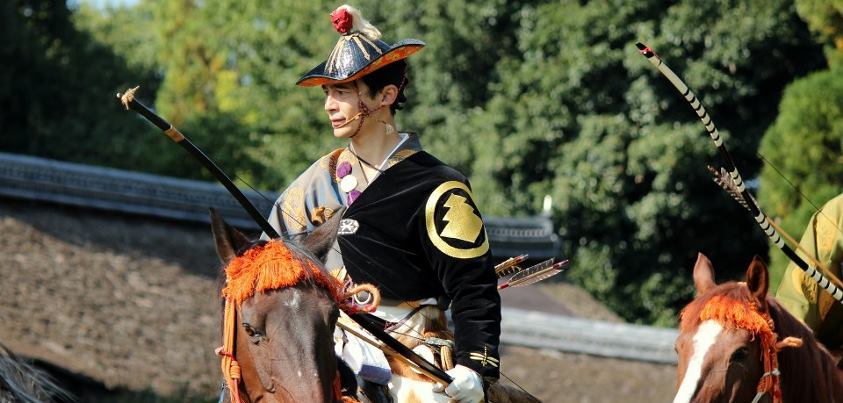
Japanese Archery evokes imagery of large Samurai armies of the Warring States Period and earlier. Today, it exists as Kyudo and has schools both in Japan and the United States where one can learn in the way of the Samurai. But living outside of Japan there are few opportunities to see Kyudo performed in the manner in which the Samurai specifically speaking in regards to mounted archery or "Yabusame" which grew from Takeda-ryu and Ogasawara-ryu. One of the best places to see such archery is at the Kasagake Matsuri held each year at the Kamigamo Shrine in Kyoto. Thanks to Kyoto Fan on Facebook, we are able to share this video with you. Enjoy!
Earlier this week, American Mishima featured the story of Frank Tanabe, A World War II Veteran of the MIS who cast his final vote in the 2012 Presidential Election. Though not famous, in his final days of life achieved world wide admiration as his photo of him in his hospital bed was circulated around the world making him an internet sensation to which he was "thrilled." Well, sadly the end has come just days after casting that final vote. In the dark days following the attack on Pearl Harbor, Frank Tanabe and his family was forced to relocate to Tule Lake and Minidoka camp in Idaho. It was there that he volunteered for the Military Intelligence Service of the US Army. Mr. Tanabe was quoted in a documentary as saying: "I wanted to do my part to prove that I was not an enemy alien, or that
none of us were – that we were true Americans. And if we ever got the
chance, we would do our best to serve our country. And we did." Mr. Tanabe died this morning of October 25th 2012 of inoperable liver cancer at the age of 93. We at American Mishima salute Mr. Tanabe for his service and thank the Tanabe Family for sharing their story with the world. Rest in Peace.
Earlier this month, we introduced you to a new feature inspired by the Military Channel we like to call "A Real Officer and a Movie" where we feature films depicting the heroic true stories of men who served the Empire of Japan during the Second World War. Earlier we introduced you to the story of Captain Oba Sakaein the 2010 Toho Studios War Epic 太平洋の奇跡−フォックスと呼ばれた男− (Translated The Miracle of the Pacific, The Man Called Fox)aka "Oba, The Last Samurai." Thanks again to our man Eddie over at Japanese Samurai DVD we would like to introduce you to another true story of one of Japan's Greatest Fighter Aces, a man who would later become enshrined at the Yasakuni Shrine as a God of War, the true story of Major General Katō Tateo in the newly digitally remastered 1969 Daiei Motion Picture Company film Rikugun Hayabusa Sentotaihe - aka "The Falcon Fighters."
But before we give you our take on the film let us introduce you to the man that in October 26, 1942 Time Magazine would call "Japan's Hero." Originally from Hokkaido, this son of an Army Sergeant who was killed in the Japan-Russo War would grow up to graduate in the 37th Class of the Imperial Japanese Army Academy in 1925 and would achieve the honorable duty of flag bearer for his Infantry Regiment. Within two years he would transfer to the Army's fledgling Air Corps and enroll at Tokorozawa Flying School. With great skill and natural aptitude for flying, he quickly rose through the ranks and became a flight instructor. By 1932 he had become the head flight instructor for the Akeno Flying School. This man would instruct a generation of new fighter pilots that would later see action over the skies of Manchuria and later in the War of the Pacific. During his time as commander of the 2nd Daitai, he claimed nine kills in China but would later disavow personal victories in favor of the collective achievements of his squadron earning both him and his men many unit citations.
Katō is one of those few Japanese Officers during the Second Sino-Japanese War to leave the area of combat to visit Germany to inspect the German Luftwaffe's technical achievements in advanced fighter design. This combined with the attachments he had with his men to which he took personal responsibility as depicted in the film for him to push for the development of the new Nakajima Ki-43 Hayabusa (Peregrine Falcon) fighter which would play a crucial in the War in the Pacific. It is believed during the course of his career he had made over 60 fighter kills which can not be accurately confirmed. However, his actions helped his unit's over all score of 260 kills over combined Allied Aircraft which quickly saw Katō promoted to Lieutenant Colonel by 1942. But as with Japan, Katō's successes would come to a fiery end on May 22nd 1942. While on an attack on a British Bristol Bomber of Squadron 60, a turret gunner named Flight Sergeant 'Jock' McLuckie raked the exposed belly of Katō's Peregrine Falcon with a burst of machine gun fire as Katō had come in for a pass sending him to a fiery crash into the sea. Katō would be posthumously awarded the rank of Major General and enshrinement at the Yakasuni Shrine as a God of War. His life would be the subject of a 1944 Propaganda film made during the War titled Katō Hayabusa Sento-Tai seen in the restored trailer below:
Two decades later in the post war era, Katō's story would be featured again in the 1969 full feature film titled "Rikugun Hayabusa Sentotaihe" - aka "The Falcon Fighters."
For the newly digitally remastered feature "The Falcon Fighters" we wrote the following synopsis: Set in the prewar days leading up to the Second Sino-Japanese War of 1937, head flight instructor Lt. Katō Tateo of the Imperial Japanese Army-Air Corps trains new volunteers from the Amry's Infantry to become Japan's next generation of fighter pilots at the Tokorozawa Flying School. Flying Kawasaki Ko-4 biplane's, Lt. Katō will train both friend and future foe alike.
But as war in China breaks out, Katō (played by Makoto Satô) now in command of the 5th Rentai will take his untested men flying antiquated planes into aerial combat against the Chinese Air Force who is now headed by Lt. Cho (played by Jun Fujimaki) who Katō both earlier befriended and personally trained himself. While Katō's squadron ultimately achieves air superiority over the skies of Manchuria, it comes at a high price in men to which each loss carries a heavy burden that he alone must carry.
As the war widens into the Second World War, Captain Katō must battle an ever advancing array of deadlier new enemies flying ever more modern fighter planes. In a time when “To Serve was to Die,” ( a literal death sentence in some sense to Western eyes) a stark contrast of Military thinking by American Generals such as George S. Patton who said "No one ever won a war by dying for his country. He won it by making the other poor bastard die for his country." While such mindset or language may have not existed among the Japanese, the conflict instilled by the Bushido code and notion to die for the Emperor as an achievement versus the realities in losses of well trained men weighed heavily on Katō. Katō would rise through the ranks and defy the military logic of the day of an indifferent Army military brass to push for the development of the new Nakajima Ki-43 Hayabusa or "Peregrine Falcon” - (the Army's answer to the Navy's famous Mitsubishi A6M Zero) in an effort to arm Japan's pilots with modern fighter planes that would give his men a fighting chance of survival in the deadly aerial combat over the Pacific.
Originally titled “Rikugun Hayabusa Sentotai,” written by Katsuya Susaki and directed by Mitsuo Murayama 1969 Daiei Motion Picture Company. Made with the technology available in the late 1960's, this rare classic WWII film "The Falcon Fighters" is the real life true story of Katō Tateo one of Japan's most legendary fighter aces of all time. Unfortunately we could not find a trailer available to show you but in lieu of such we have uploaded the film's opening so you may get a feel for this film.
Please bear in mind, as "American-jin" we are not trying to glorify war or make any political statements or arguments about Japan's wartime past. It is often said there are both heroes and villains on both sides to any conflict. What we at American Mishima believe is in sharing the stories not so well known on this side of the Pacific and worthy of retelling. We hope that the story of Katō Tateo gets retold yet again in a modern motion picture with today's talent and technology. Such men are a rare breed not to be forgotten. Their shared sacrifices made possible the world we have today. Therefore, we offer a salute and shared admiration for Major General Katō Tateo and the men on all sides who fought bravely for their countries in what was the tragedy that was the Second World War.
As the World War Two or Greatest Generation leaves us in ever greater numbers, We at American Mishima from time to time like to feature these old Warriors who make the news. As previously posted on CNN, seen here in the above photo lies Frank Tanabe of Honolulu Hawaii who in 2010 was among a group of Japanese-Americans who were awarded the Congressional
Gold Medal as part of the Military Intelligence Service Unit during
World War II. (Better late than never no?) As seen in the photo, Mr. Tanabe 93, cast his final mail in vote as he is in the final stages of inoperable liver cancer. Mr. Tanabe grew up in the Niesei community of Seattle and attended University of Washington when he was forced to drop out and abandon everything they owned in compliance with Executive Order 9066 to be put on trains and forced into the Interment Camps that imprisoned Japanese Americans following the Japanese attack on Pearl Harbor during one of America's darkest chapters of World War II.
Upon hearing that there was a need for interpreters, Mr. Tanabe volunteered for the US. Army while his family remained imprisoned. As previously posted on CNN: According to his daughters, Frank has never missed a presidential
election, and wasn't about to let his illness deter him from voting this
time around. Since this photo was taken and uploaded to the internet, Mr. Tanabe's story has been reposted and seen around the world including here on American Mishima. His daughter Barbara said that she has been telling her dad about all of the internet "buzz" and is sure he is "thrilled about it." "He is very patriotic, very proud," she said, adding that her father instilled a similar sense of appreciation to his children. "He always told us it was very important to vote, because he saw his
comrades in arms fight and die for American rights," she said. Among those, she added, was the right to vote. As the Greatest Generation and in particular those MIS and Go For Broke
Japanese Americans leave us there will be fewer opportunities to
feature them, So here at American Mishima we would like to offer one final salute for his service and long standing patriotism. Thank you Mr. Tanabe!
ありがとうございます!
The Dragon of Echigo, Uesugi Kenshin (1530-1578), Guardian of the North still stands at Kasugayama Castle in present day Niigata Prefecture. Along with his fiercest rival & greatest admirer Takeda Shingen of Kai, Uesugi Kenshin remains one of the most legendary warlords of the Sengoku Jidai - The Warring States Period of Japan.
“American Mishima” is the work of Louis Rosas, the son of Mexican Immigrants, whose father served in Vietnam for the US Army and who grew up on glamorized war films and military aviation in the sleepy seaside plains of Oxnard, Calif. With an early fascination of the Second World War embedded in his young mind during the post-Vietnam era, it was his exposure to Akira Kurosawa's samurai epic Ran (Toho, 1985) that changed his views of war while creating a lasting impression of Japanese culture and history. Further inspired by the works of Japanese writer Yukio Mishima, Rosas would go on to study Japanese language and swordsmanship, which led him to the practice of Shingon Buddhism and Shinto. Rosas is also a former student of Shinkendo, the ideal and practice of the samurai code of Bushido in the modern world, which helped shape the creative force that is “American Mishima.”




 Posts
Posts