We at American Mishima are pleased to announce the release of our latest historical fiction novel THE SETTING SUN - Death and Deception on The Bakumatsu Trail. Set in 1966 Japan, this story traverses time going back to the Mexican-American War, to the adventures of John Manjiro, and ultimately to the seeds of revolt in the closing days of the Tokugawa Shogunate! Please read our story Synopsis below:
When William Merrick of the U.S. Consulate in Hakodate Japan is tasked
to rescue a group of shipwrecked Americans en route to the Shogunate
Capital of Edo, he unwittingly becomes swept up in a deadly plot by the
secretive Itabashi Faction in their scheme to overthrow the Old Order of
the Tokugawa Shogunate whose dwindling 266 year rule is under threat
from open rebellion and all out civil war. In a feudal land ruled by
powerful Samurai Warlords divided by loyalties between their Emperor and
Shogun, the balance of power and the future of an Empire rests with one
man under The Setting Sun.
December 10th marks the 145th anniversary of the assassination of the visionary Samurai-Statesman Sakamoto Ryoma of Tosa. He was indisputably the architect and founding father of modern Japan. He is immortalized in books, films, NHK Taiga Dramas (such as the recent Atsuhime & Ryomaden), and in bronze statues throughout Japan. What a different Japan would be had he not sought to kill Katsu Kaishu and by chance listened to what he had to say that opened his eyes and made Ryoma his disciple who inspired by the United States envisioned a new Japan where people were equal. Through Katsu Kaishu he realized in order for Japan to survive it had to modernize but to do that he needed to unite the various clans seeking to overthrow the Tokugawa Shogunate to work for this new Japan. He assassinated by members of the pro-shogunate Mimawarigumi at the age of 33 on his birthday at the Omiya Inn in Kyoto with Nakaoka Shintaro. He is still beloved by many in Japan 145 years after his untimely tragic death and will continue to live on in both popular culture and the hearts of many for generations to come.
The Bakumatsu Period of Japan – The Last days of the Tokugawa Shogunate has made for great fodder for film makers seeking to tell the tales of Japan's turbulent series of dramatic historical events that took place during the nineteenth century. In such, 2010 Toei Company's Sakuradamon no gai hen is no exception. Better known here as The Sakurada Gate Incident Japanese Film Director Jun'ya Sato takes up the difficult task of recreating the events that set the stage for revolution and the ultimate goal of Imperial Restoration.
This story centers around a Mito-han Samurai who had just come out from being under confinement named Seki Tetsunosuke (played by Osawa Takao) is has joined a plot by other Mito Clansmen to assassinate the Tairo or Great Elder Ii Naosuke (played by Ibu Masato) who in the aloof Shogun Iesada's absence or interest in government affairs has signed treaties without Imperial Consent with the American Consul Townsend Harris in the Treaty of Amity & Commerce in order to head off Japan's most imminent threat to Japan that has sent the county into crisis.
Being fully aware of Japan's ineffective coastal defenses, the Bakufu makes these decisions to bide time while they devise a strategy to deal with the threat poised by the black ships of the western powers. Having committing the crime of violating the Mikado's law (Emperor Komei) the Mito han informed the Imperial Court and sought sanction. An Imperial Writ from the Mikado was given directly by the court to the Mito breaking the protocol which angered the Bakufu in Edo. This resulted in the Ansei Purge – Ii Naosuke's reign of terror that resulted in over 100 arrests and eight executions of those who opposed Ii's actions which forces the hand of the Mito to take action.
Aware of such plots and dire warnings of threats to his life, Ii Naosuke chooses to ignore them at his peril by not increasing the number of his guard. "The Bakufu sets the number."
One a cold morning of March 1860 the assassination is carried out in front of the Sakurada Gate of Edo Castle in a bloody sword battle that resulted in the death of Ii Naosuke. It is truly a brutal yet exhilarating scene and the highlight of this film depicting realistic sword action in the most ugly violent of terms.
While Seki Tetsunosuke is merely tasked to record and confirm the Tairo's death, his battle for survival in the face of betrayal by other Han who had pledged to support their cause of Sonno Joi must be overcome. While their timing was not supported by Sakamoto Ryoma, it is up to Seki to live long enough to see the fruit of the Mito's actions and those who died as a result were not in vain.
Now we have read other bloggers take on this film many of which universally loathed it's slow pace and difficult action. If you are looking to compare this to 13 Assassins, you are going to be disappointed and perhaps by billing this as an action film is in error. In contrast, if you love the history of the Bakumatsu period this is worth viewing. We appreciate that each member of the Mito plot was listed with their ages at the time of death.
In one such poignant scene we see a father and son cornered by the Magistrates in Osaka. In their attempt to escape, the father jumps from the second story of a Ryokan and injures his leg making escape impossible. With no way out and swords drawn, he limps over to a nearby Buddhist Temple and asks as a warrior to be given use of a room so he may die like a Samurai.
Minutes later, both the father and his 19 year old son are tragically found dead atop blood soaked tatami mat. But the tragic consequences doesn't end there.
For many of the captured plotters, those associated with the Mito, and those charged with failing to protect the Tairo, such dignity is denied as they are led out to be beheaded. It's scenes like this I believe many viewers who tune out after the first thirty minutes miss out.
Telling such a complex tale of this nature is never an easy task. Just ask the makers of Kon Ichikawa's 47 Ronin. The 47th NHK Taiga Drama Atsuhime tried to tell the story of Ii Naosuke & the Ansei Purge in the span of two months where director Jun'ya Sato accomplishes this in just a little over two hours. We will concede, at times this film's pacing seems flat and its most exciting scene is the assassination itself. The real story in our minds from moment one should have been solely on what happens to Seki as he tries to evade the Bakufu Magistrates pursuing him. With wanted posters circulated everywhere and no place to go, he will be challenged by swordsman and anyone who fails to protect him. Anyone who loves good fugitive movies can appreciate where this film took in the second hour. To us that was the real story behind these tragic events that cost the lives of anyone connected to him. While some features may look familiar to Samurai Assassin, and it's second hour flies through like Toshiro Mifune's Shinsengumi, this film will challenge if not educate audiences and history buffs alike. While some people may find the first hour uninspiring, the overall film with it's lighting, set design, costume, great cast, and locations makes the grade. Anyone looking to write a paper of the Ansei Purge or that of the Mito Han would be remiss to pass on this film. It very well may change your view of the Mito Samurai who died doing what they believed was in the best interest to save Japan.
While history can be entertaining, this is not mere entertainment. This
is an important film conceived by people of the former Mito domain
containing serious drama not for the light hearted or easy action oriented.
It is both a tragic tale and one of the most important events of a
turbulent time that forever changed the course of Japan's future. As
said in closing scenes during the Surrender of Edo Castle, Saigo
Takamori of Satsuma seen in command of the newly formed Imperial Army
says: “It all started here.”
To find a copy of The Sakurada Gate
Incident with good English Subtitles please visit our good tomodachi
Eddie @
Japanesesamuraidvd.com
I have been writing a fictional novel set in the Bakumatsu period of Japan for close to a year now. And during that year, I have had to do some painstaking research in order to make my story viable to my most critical audience. In one of my chapters, I tell the tale how my fictional protagonist William Merrick had gone from the disillusionment of the Mexican American War to finding his way to San Francisco during the California Gold Rush where along the way he befriends Nakahama “John” Manjiro. It is through these circumstances that the two friends will meet again in 1860 when the Shogunate Warship Kanrin Maru arrives in San Francisco with the first Japanese Embassy Delegation to America.
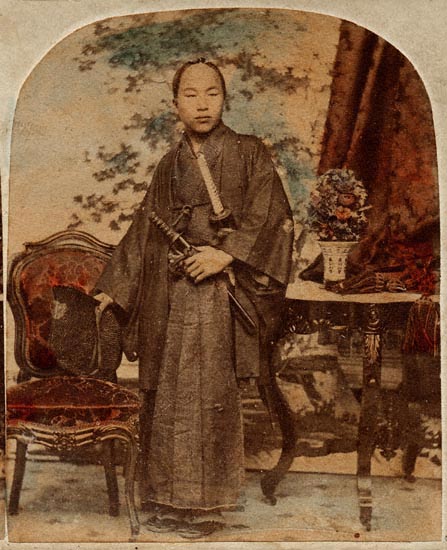
For this chapter I had read through Masao Miyoshi’s As We Saw Them to gain further insight as to what happened during that first official visit by any Japanese government to an American City. This was most helpful in understanding the likes of Katsu Kaishu and Master Scholar Fukuzawa Yukichi who make careful brief appearances in my book. In reading of their cross cultural adventure I had come across a peculiar story of a curious young sixteen year old Samurai named Tateishi Onojirō whose looks made him an overnight sensation and darling of the American Press.
“Tommy” as he had become known worked as a second level interpreter. He held no great title or high status in Japan but in America he was mobbed by women like any modern day rockstar. Onojirō had been described as a darling fellow and Japanese Prince by sailors who liked his less than repressed character as opposed to the remainder of the delegation whose composure was restricted by decorum demanded by those representing the Shogunate. Wherever this kid went, Onojirō was surrounded by crowds of women seeking his autograph and bestowing flattery. His love letters and poems became front page fodder which only increased his popularity. Of course this sounds like typical celebrity fair but when you consider this took place in 1860 one has to go wow!
Onojirō’s place in history may have only occupied a meager footnote in the chronicles of the 1860 voyage to America but his image that was so illustrated by the American Press of the 1860’s still exists in these rare photographs of the former teen sensation. I can only imagine what kind of ego he must had developed and what let down awaited him when he returned to Japan with no throngs of female admirers awaiting him. At least he survived the Imperial Restoration to tell the tale and later returned to America in 1871. By then he was just another twenty eight year old former Samurai. We will never know if he got over his former teen fame for he disappeared into obscurity. All we know is that in the last recorded sighting he was ever still the ladies man even if he was no longer popular.
The Shinsengumi has been the subect of films and television drama for some time. I had first heard of them when I first had seen the 1969 classic film of the same title starring Toshiro Mifune. But looking back to that film, I was left unsatisfied due to the way they tried to tell a long in depth story in brief. So recently I recently purchased a bootleg copy of the 2004 NHK 43rd Taiga Drama Shinsengumi that featured the exploits of the Shogun's "Newly Selected Corps" that policed the streets of Mibu to protect the Tokugawa Shogun in Kyoto during the last years of the Bakumatsu Period. So far we are thirteen episodes out of this 49 episode drama and we are loving it!
Shinsengumi stars Katori Shingo as Kondo Isami - the leader of the Shinsengumi, Yamamoto Koji as Hijikata Toshizou, and Fujiwara Tatsuya (who you may remember from Battle Royale) as the famed progeny Okita Soji. So far the acting is superb and the storyline riviting in the fashion you would come to expect from an NHK Taiga Drama. Depending on who you talk to, the Shinsengumi will always been seen as heroes, villianous ronin, or stubborn patriots who are both villified and revered to this day. We still have many episodes to go, so we will write more about this as we continue this series.
It’s been an interesting Ichi-Gatsu of 2010. I started this year as I do every year in Little Tokyo. Every year I run into this same girl who wears a light green kimono who sells fortunes out of a wooden box. I dreaded her appearance this year given that I received a bad fortune from her last year. 2009 was a terrible year for me. I should have known given that the girl did not smile as she moved around Little Tokyo until she was selling fortunes. That’s a red flag I should have paid attention to last year. This year I was on guard. I received a good Omikuji fortune at the Koyasan Temple so I was not about to press my luck. It’s hard to say where I am at with it so early in the year so I thought I would reflect on that for a moment. I’m not sleeping very much which has played havoc on my Shinkendo training and progress writing my book. Despite my participation in all of the New Years events I’m still living on the edge since losing my unemployment last December. But all is not lost. For the first time in months my phone has been ringing with potential work prospects things are starting to pick up. Computer work is not what I really want to do but until I can get back into the film industry and write books and screenplays, this will have to do to help me back on my feet so one day I can live by my creativity.
The Year of the Tiger is supposed to be one of intense creative energies and so far But before I celebrate my lucky arrows I will remain cautious and continue to hunt for work while I continue to write my book. My book has undergone some major revisions since its initial thirty page screen play first printed last June of 2009. It has gone from screen play to full blow historical novel with close to eighty characters to which some are actual historical figures from Japan’s history of the late Bakumatsu Period. Where I am at right now is where my protagonist William Merrick has boarded the Japanese Warship Kaiten with the Elder Superintendant Okuda. They have set sail steaming out of Hakodate and on through the Tsugaru Straits to open seas heading South by Southwest to their clandestine rendezvous in Shimoda before the Kaiten will sail off to join the 2nd Choshu Expedition. My selected quote for this chapter comes from Captain Ikunosuke; “Today we fight for the Shogun. Tomorrow we may fight for our very lives.” It is a scene I could easily envision. I will reveal more of my story later for there is much writing ahead. This has proved to be a daunting challenge. Not only must I take care when my fictional characters interact with historical figures the story must also follow a degree of respect towards those figures as well as their logistical disposition corresponding with their recorded whereabouts of the time. So much to consider knowing that anyone who would be remotely interested in my work will be well versed in history so there is no margin for error because I know they will call me on it. So to avoid having my novel being panned as a literary suppository careful attention to detail and above all historical plausibility is a must.
So there we go. Ni-Gatsu is coming and I will hopefully gain some worthwhile employment. Juggling the time between work, Shinkendo, writing, and my relationship will be task. I am not sure how I will do it considering the slow progress I have made with my story. Up until now, the stress of unemployment and now the added stress of the Shinkendo Honbu Dojo’s potential move out of Little Tokyo has me on edge. The new Korean owners are forcing the Obata’s out of their dojo to make way for one more restaurant in the Little Tokyo Galleria. Not knowing where we will relocate has stressed me out. We have until mid February to find a new location. This is no good. Especially, when you are trying to write. That feeling of being constricted comes into mind. That makes it impossible to write with such distractions. My work search alone has eaten away at my writing time which only applies when I am motivated to write. The story has to flow and come alive for me in order to tell it. I just can’t set aside a narrow time slot in my day to churn out pages. I can do that with a screen play but not with a novel. It just doesn’t work that way for me.
There is just so much to consider when writing historical fiction. I not only have to go back in time but to a place and a culture that no longer exists. It would help if I could magically pull a rabbit out of my hat and fly to the West Izu peninsula but this is not possible. This adds to the complexity of writing a novel set in a country that I have never set foot in. However I will remain optimistic and hopefully find a way to complete this project and get it published. It will likely take place after I copy write and register my “Little Tokyo” comedy screen play with the WGA. Meanwhile I will continue to train and write until I can live off my creativity and make my way to the Land of the Rising Sun. Japan will be there for me. At least that’s what I have to tell myself. One way or another I will get there. And the girl in the green kimono? Well just like the year before she did not smile until she sold her fortunes. This time I smiled and walked away. I’m really superstitious about these things. I got my good fortune at the Temple and I enjoyed the good fortune of being around my Japanese friends and those I am close to. In that sense I did have some good fortune and perhaps there is more to come. I think this Tora no Toshi has some potential. We’ll see what comes next. We're only getting started!
I'm pleased to present as my first official post a preview of my debut novel Dorama Haiku. My book is set in three acts in three different time periods covering three different dramas.
Act I - Kaikoku no Higeki - A Foreign Tragedy.
This is a historical drama set in Japan of 1866 during the last days of the Tokugawa Shogunate. Tragedy Needs No Translation.
Act II - The Depth of Echoes aka The Passenger
Is a modern day ghost story set in contemporary times in New York City. A requiem for the restless!
Act III - IISHIMARU
Is a Science Fiction story set in the far reaches of space dealing with love, and loss that only desolation knows.
I've been working on it all summer and some of you have been dying to read it so here is just a preview from the latest draft from Act I : Kaikoku no Higeki - A Foreign Tragedy.
I hope you enjoy!
*L*
- One paragrah from Chapter 3 - Kaikoku no Higeki - A Foreign Tragedy
This scene takes place at the American Consulate in Hakodate' Ezo May 1866. In this scene William Merrick who works as a translator for the American Consulate is briefed on his precarious new assignment. His mission is to escort the stranded Wayfield Party safely from Shimoda to the capitol in Edo. What complicates his task is the newly imposed state of martial law implimented by the Bakufu Government in Edo. This has restricted travel to and from Edo while the Shogun leads a doomed army to attack the powerful Choshu Clan. This story is set during the Second Choshu Expedition of 1966.
- From Chapter 3
A look of concern appeared on Merrick’s face as he looked around the room as the men understood the serious implications of the situation. “What of the Bakufu Navy?” inquired Merrick. 1st Officer Ichiro looked to Superintendant Okuda who nodded with caution. “The battle will be on land. There is little we can do,” expressed 1st Officer Ichiro as the Elder Okuda sat in silence. Vice Consul Bertrand interjected; “There are many factions in Edo and Kyoto that are aligning against the Tokugawa Shogun.” The grim faced Colburn added; “The Bakufu assures us they have control of the situation but the reality is that the Bakufu in Edo may collapse and the consequence of that collapse could have serious implications for all westerners here.” Merrick had seen the banners reading “Sonno-jōi” – Expel the Barbarian’ along the outskirts of the foreign quarters of Edo. He had been well aware of the anti-western sentiments that existed in various parts of the country. Merrick could only look around then room and come to ask the most dreadful of possibilities. “And what if the Shogun is killed?” asked Merrick. “Chaos,” replied the Elder Okuda in a deep reserved voice. “Absolute Chaos.”
“American Mishima” is the work of Louis Rosas, the son of Mexican Immigrants, whose father served in Vietnam for the US Army and who grew up on glamorized war films and military aviation in the sleepy seaside plains of Oxnard, Calif. With an early fascination of the Second World War embedded in his young mind during the post-Vietnam era, it was his exposure to Akira Kurosawa's samurai epic Ran (Toho, 1985) that changed his views of war while creating a lasting impression of Japanese culture and history. Further inspired by the works of Japanese writer Yukio Mishima, Rosas would go on to study Japanese language and swordsmanship, which led him to the practice of Shingon Buddhism and Shinto. Rosas is also a former student of Shinkendo, the ideal and practice of the samurai code of Bushido in the modern world, which helped shape the creative force that is “American Mishima.”




 Posts