Late last year, we had pulled The Setting Sun: Death and Deception on the Bakumatsu Trail for a major re-edit and reformat. New editing software and improved techniques allowed us to go back and fix this story. What's changed is the cover and the book title which has been streamlined to just The Setting Sun. There is also a change in the overall length of the story. We also removed some of the Japanese dialog as well as some other elements which took away from the story. We at American Mishima hope you will give this epic tale set in 1860's Japan by American Mishima author Louis Edward Rosas a second chance for we believe you will enjoy this improved story now available on Paperback and eBook. An Audiobook will also be available soon. To get your copy, please visit the following link for THE SETTING SUN. Thank you!
Seen Here: American Mishima author Louis Edward Rosas unveils our latest Samurai Action/Adventure novel THE SETTING SUN: Death and Deception on the Bakumatsu Trail at Vroman's Bookstore & Hastings Ranch in Pasadena California. in our first ever bookstore debut for any of our American Mishima titles. This book is available in both store locations for the next three months (or longer depending on the popularity) and on their website. You can also find our book on Amazon but if you live locally, please support us at Vroman's. Thank you!
During the fall of 2014 through the weekend of February 1st 2015 the Los Angeles County Museum of Art (LACMA) hosted an exhibition of rare Samurai Armor to the thrill of throngs of visitors. Much of the armor was set in dramatic displays evoking the imagery of Kurosawa Samurai Classic Films yet in truth most of the armor displayed never saw any great battles at all. In fact, most of the armor displayed was made during the Edo Period after the last Siege at Osaka Castle meaning the closest any of these armor got to a battle was likely a parade or re-enactment.
All particulars aside, one could still appreciate the elaborate displays of uniquely crafted armor and helmet crests worn by prominent Samurai or Daimyo giving you a sense of what earlier armor might have looked like at events such as the great Battle at Sekigahara or the epic clashes between the Uesugi and Takeda Clans or that of the Oda Clan.
Behold this finely crafted helmet bearing the Mon of the Tokugawa Clan. This would be not unlike something worn by Ieyasu Tokugawa himself during battle.
While there were few weapons on display, what we could see displayed portrayed a high respect for it's owner. If these swords could talk, what would they tell us?
Note the Matchlock Arquebus on display which the Oda Clan made the most effective use of. With 3000 of these primitive rifles, the Oda Clan destroyed the greatest Cavalry ever seen by firing in cyclical fashion.
Not to be excluded were the presence of archers and their lethal quivers which the Samurai were Masters.
Such elaborate tools of the Samuri's Archery would make any modern day Kyudo master dream.
Note the detail of these helmets. Unfortunately, we were rushed as we took these photos so we could not provide you with details as to their origins. That being said we can tell you these were largely exclusively from the Edo Period of Peace.
Note to the right face masks. There were more of them but we couldn't get good photos of them.
In this photo we see the Naginata which was more commonly used by foot soldiers or farmers conscripted to serve their lords in times of battle. To the right is a set of boy armor similar to what might have been worn by Katsuyori Takeda or Hidetsugu Toyotomi.
This one made me think of Takeda Shingen. Kagamusha Anyone?
Peacetime or not, you would not would have wanted to cross swords with these Samurai.
Who is to say what attachment the wearer and the armor may have had.
You could not help but feel the presence of these Samurai still at their posts waiting to fight and if necessary die for their Lord.
I could see one the faces of visiting Nihonjin and Nisei a sense of pride as they looked on and explained this period of their history to their children. Even for a Hakujin, we were awed by the might of the Samurai Display.
We at American Mishima are thankful to both LACMA and the Government of Japan for allowing us to enjoy this awesome display into a window of Japan's Medieval past.
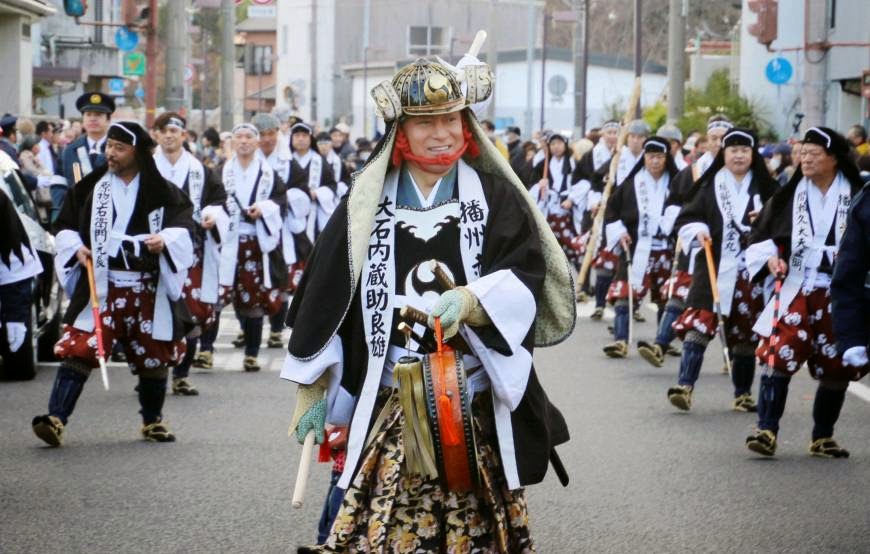
Well almost! As seen here, Japanese actor Ken Matsudaira appears leading a procession of Samurai re-enactors in the streets of Ako, Hyogo Prefecture Japan to recreate the famous 47 Ako Ronin who martyred themselves on this date December 14th 1702 in their quest to avenge their lord. It is forever known as the ultimate act of loyalty in Samurai history.
Seen here is the first Promotional Trailer for American Mishima's epic generational saga: THE SOLDIER AND THE SAMURAI by Louis Edward Rosas.This book is available on Amazon.com While this is is only a visual representation made from an earlier film, we hope that this book will one day be made into a full length feature film that will convey the story's epic scale for all to behold!
In continuing with the
unique on-going cross cultural exchange of Samurai Jidaigeki and American
Western Films that dates back to the golden age of Akira Kurosawa’s Seven
Samurai, Award
WinningWriter / Director Sang-il Lee (Hula Garu) brings us
the latest installment inYurusarezaru Mono (許されざる者)Unforgiven.
Inspired by the original 1992 Academy Award winning Clint Eastwood film Unforgiven, Director Sang-il Lee brilliantly takes us from the American Old West and resets the storyline in Hokkaido Japan at the end of the fall of the Shogunate. Starring Japanese acting great Ken Watanabe as “Jubei the Killer,” the story opens in 1869 (Meiji 2) with the last remnants of the Shoguns forces desperately fleeing north to the freezing wilds of Ezo (Hokkaido) to escape the pursuing government forces comprised of Satsuma troops bent on their destruction. These were desperate times for the Samurai and one that would not last after the decisive battle at Goryoukaku.
Fast forward eleven years later we find Jubei living on a barren windswept farm along the north eastern shore of Hokkaido. Jubei now retired raises two children he had with an Ainu woman he married who since died leaving him a widower. The cold bleak land produces little food leaving Jubei to ponder how he will care for his children in such harsh conditions until a lone horsemen rides up to his farm and recognizes “Jubei the Killer,” who is surprised to find he is still alive. The horseman is an aging old Samurai and former comrade named Kingo Baba (Akira Emoto) from “The Elite Special Corps of Samurai” that once patrolled Kyoto – A veiled reference to the famous doomed Samurai the Shinsengumi.
Kingo is on a quest to collect a bounty offered by a group of prostitutes who are seeking to avenge one of their own named Natsume (Shiori Katsuna) who had been beaten and disfigured by two former Samurai of the Sendai Clan who had resettled in Hokkaido. They had carved the woman’s face in a drunken rage after believing that the girl had laughed at Sanosuke Hotta’s (Yukiyoshi Ozawa) inadequacies.
Both Sanosuke and his brother Unosuke Hotta (Takahiro Miura) are initially tied up by the brothel owner Kihachi (Yoshimasa Kondo) but to the outrage of the women, the Police Chief Ichizo Oishi (Koichi Sato) lets them go on the condition they compensate the Kihachi with six horses, an inadequate settlement to Natsume’s suffering. But despite the protests of the senior most of prostitutes named Okaji (Eiko Koike), Chief Oishi brutally warns that there will be no further acts of revenge and that the case is closed.
Unsatisfied with Chief Oishi’s resolution, the fallen women agree to pull their earnings to offer a bounty of 1000 Yen to any man who kills the two perpetrators. This draws the attention of many former Samurai seeking to earn a living in the barren north. A retired Samurai of the Choshu Clan rides into town in a horse drawn cart ignoring the posted sign warning “No Guns or Swords Allowed.” The Samurai named Masaharu Katoji (Jun Kunimura) dressed in full Samurai attire wearing the two swords steps into the brothel for a meal and a drink with a lanky western attired writer named Yasaburo Himeji (Kenichi Takito) who is there to write Masaharu’s biography.
Within minutes he is confronted by a former Samurai from Satsuma who challenges him to a sword duel, a duel in which Masaharu’s superior skill humiliates the Satsuma Samurai. But no sooner than Masaharu sheaths his sword he is surrounded by Oishi’s men who have their rifles trained on him. Chief Oishi scolds him for ignoring the sign forbidding weapons in his town and forces him to surrender his swords. Once in custody, Oishi sadistically beats the former Samurai to near death before sending him home with his sword deliberately bent and broken. Oishi warns that “All Samurai Scum are not welcome in his town.”
Enter Jubei the Killer. Hours after Kingo left his farm to pursue the whores bounty, Jubei contemplates Kingo’s offer to split the reward after his son pulled up two undersized potatoes that were not fit to eat. His family’s plight weighs heavy on him as does his pledge to his late wife to never kill or drink again. As he looks into the sad eyes of his son and daughter, he concludes that he must embark on this bounty hunt in order to save his family. For this he will leave his children alone for two weeks advising them to kill a chicken if they get hungry and to go to the Ainu if there is any trouble. And in the cinematic repose of the original 1992 film, the repentant killer rides away.
The very next day Jubei catches up with Kingo. But they would not ride alone. Enter the crazy drunken braggart Ainu Goro Sawada (Yuya Yagira) who boasts he has killed six men. Goro follows the two former Samurai aware that Jubei is reputed to have killed soldiers from Satsuma during the Boshin War and further killed women and children who were Christians at Yabari, a claim which Jubei will not acknowledge and is a matter of great contention. But when the trio encounters a group of local police brutalizing an Ainu village for observing funeral customs, Goro counts on Jubei’s brutality to help the defenseless Ainu which both Jubei and Kingo refuse. Kingo in turn urges Jubei to tell Goro the truth that it was the Government soldiers not Jubei that killed the Christians of Yabari that earned him his brutal reputation as a killer. This disappoints Goro who is still determined to collect a share of the bounty.
Moving on, the trio of bounty hunters arrives at the town on a dark rainy night. Jubei has taken ill and sits for a warm drink while Kino and Goro play with the women upstairs. Enter Chief Oishi who recognizes Jubei the Killer and challenges him to a fight. Jubei is clearly in no condition to fight. As a result, Chief Oishi brutally assaults Jubei beating him mercilessly and carving his face with a broken bottle while saying “A villain should wear a villains’ mark.”
Chief Oishi beats and kicks Jubei within an inch of his life but chooses to let the humiliated former Samurai crawl out into the rain soaked mud to be rescued by Kingo and Goro with the help of the prostitutes who are mortified by Oishi’s brutality. Days later, the women helped Kingo and Goro bring Jubei back from the brink of death. Kingo stitches Jubei’s face and brings him to his feet. Oishi is not forgotten by Jubei but first they must hunt down the Hotta men. They first find Unosuke Hotta on a hunting party which they ambush. Kingo takes the first shot wounding Unosuke but it is Jubei who will finish him off. After seeing Jubei perform the coup de gras, Kingo decides he can no longer kill and leaves Jubei and Goro to collect the bounty. But to do that, the two men will have to ride into to town where the other Hotta is being held by Oishi. Sanosuke Hotta, the unrepentant perpetrator of the initial crime is let outside of the police station to use the outhouse. It is there in a brazen daylight assault that Goro attacks Hotta. Goro and Jubei escape in a hail of gunfire in which Oishi fails to shoot Jubei off his horse and vows to exact revenge.
Just like in American Westerns, the villainous police Chief Oishi deputizes all former Samurai he can muster to hunt down Jubei but in his quest he finds Kingo who has left the bounty for his own. Kingo succumbs to Oishi’s brutality and is strung up to die in the freezing snow with a sign dangling from his neck warning any bounty hunters that this will happen to them. But before the news gets to Jubei, Goro reveals what Jubei has known all along that Goro has never really killed anyone before and as a result sworn off killing. Once Natsume arrives with the reward money, she tells Jubei of Kingo’s fate. Now it will be up to Jubei the Killer to exact a revenge sequence that will shake the soul to its deepest core.
In a film reminiscent to Ken Watanabe’s 2005 film Kita No Zeronen- Year One in the North, Unforgiven revisits both the forbidding natural wonders of Hokkaido and the plight of the indigenous Ainu people during the early days of the Meiji Era. The juxtaposition of Samurai to Western drama is most adequately executed in perfect form aligning with the historical events of those turbulent times. Like the original, this gritty brutal drama evokes both the realism of sword combat and the consequences of violence. As such, it has won praise from Clint Eastwood himself! Ken Watanabe has once again proven why he is the master thespian of our time as Jubei the Killer and the best of Japan’s film industry in this cinematic masterpiece Unforgiven. While not for the faint hearted, Sang-il Lee’s Unforgiven has our vote as one of the greatest film remakes of all time.
“American Mishima” is the work of Louis Rosas, the son of Mexican Immigrants, whose father served in Vietnam for the US Army and who grew up on glamorized war films and military aviation in the sleepy seaside plains of Oxnard, Calif. With an early fascination of the Second World War embedded in his young mind during the post-Vietnam era, it was his exposure to Akira Kurosawa's samurai epic Ran (Toho, 1985) that changed his views of war while creating a lasting impression of Japanese culture and history. Further inspired by the works of Japanese writer Yukio Mishima, Rosas would go on to study Japanese language and swordsmanship, which led him to the practice of Shingon Buddhism and Shinto. Rosas is also a former student of Shinkendo, the ideal and practice of the samurai code of Bushido in the modern world, which helped shape the creative force that is “American Mishima.”




 Posts
Posts