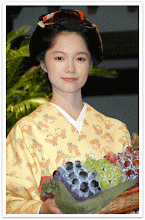
Seen here is Shinto PriestessIzumi Hasegawa of the Shusse Inari Shrine of America performing the Nagoshi-no-Harae - Mid-Year Purification in West Los Angeles. The event was attended by a small group of people who each participated in the ceremony. While it has not been possible to travel up to Washington State to the Grand Tsubaki Shrine of America, this mobile shrine enabled us to still participate in the Mid Year Purification in person. While there has not been an established Jinja in Los Angeles in years, We welcome Reverend Hasegawa's small mobile shrine to help our connection with nature and Kamisama going in this complex urban setting we live in.
Reverend Hasegawa seen left with volunteers setting up the traditional wreath participants walk through in a figure eight pattern with a series of bows of reverence.
A small tent setup to greet participants and the mobile shrine is seen in the background.
A quick view of the altar. While Hasegawa Sensei was okay with taking photos, we opted to keep this to a bare minimum out of respect as well as to not become a distrationfrom the work at hand. While he have seen the Shusse Inari Shrine of America small mobile shrine at New Years, we hope to see more of them here in Los Angeles and wish them great success in their effort to bring Shinto back to the City of Angels. To learn more about the Shusse Inari Shrine of America please visit their website.
This past Sunday we attended a mini-Sakura Matsuri that was hosted by the Japan Foundation held at Brand Park in the Los Angeles Suburb of Glendale. To our suprise, Brand Park is home to the Shoseian (Whispering Pine) Japanese Tea House & Friendship Garden. According to the City of Glendale's website, this beautiful tea house was built in 1974 through the combined efforts of the sister cities of Glendale and Higashi-Osaka. The name Whispering Pine Tea House was given by the Fifteenth Grand Tea Master of the Urasenke School of Tea in Japan.
We can't emphasize how beautiful this place is but we can guarantee this will not be our only visit. We could only imagine how special it would be to attend an actual Tea Ceremony would be in such a setting.
The Shoseian Tea House has been designated as a historical landmark and in our humble opinion a hidden gem of Japanese Culture nestled at the foot of the Verdugo Mountains to enjoy.
If you would like to learn more of this unique Japanese Tea House, please visit their website at shoseianteahouse.com
Seen here is Filmmaker Jeffrey Gee Chin, left, and sculptor Miles Endo, holding the
far end of veil, reveal an 8-foot-tall steel lantern in Little Tokyo's
Japanese Village Plaza. The monument is dedicated to the Japanese-born
late civil rights activist Sei Fujii. (Irfan Khan / Los Angeles Times)
Noh Theater is as unique an art form as it is a cultural treasure of Japan known the world over. This musical drama best known for it's exquisite beauty, rich costumes, and array of masks are steeped in symbolism that conjures an era long past to the 13th Century predating Kabuki. We at American Mishima have been fortunate enough to have seen a few Noh Theater performances here in the City of Los Angeles, but these opportunities are rare. It was by chance that we were fortunate enough to attend the Japan Foundation's recent lecture on Noh this last March 13th at their Wilshire Blvd location. The lecture would be for the most part conducted in Japanese by famed Noh Performer Tatsushige Udaka and translated by his wife & Noh Performer Haruna Tanaka. In his lecture, Mr. Udaka shared his vast knowledge of Noh's place in Japanese history and its cultural significance. In this lecture attendee's were given a rare opportunity to pass around sample swatches of the material that is most widely used in Noh Costumes as well as closeup views to the elaborate costumes that span over 100 years in age.
Mr. Udaka talked at length as to the usage of the famous Noh Masks which later made for an entertaining question and answer session in which we had to ask about the actors personal association with their characters. Most particular of interest was that of the famed "Oni" (Demon) mask made famous by the 1964 film Onibaba in which a jealous mother poses as a demon to scare her wayward daughter into submission.
What struck us was his explanation that unlike here in the West, the demon mask represents the state of the heart and not an actual demon. This is not to discount actual belief in such entities but rather to further exemplify the expression of pure jealousy. Traditionally, the demon mask represents the jealous rage of a beautiful woman whose heart reveals her ugliness. When asked about tales of possession, Mr. Udaka recalled one famous story of a Noh Performer who once became so entranced by the demon mask that he cut his own face off to better fit the undersized mask. Such tales are the rare exception but for us it was an opportunity to get the actor's perspective on the lore of the fearsome mask.
While it wasn't our intention to scare anyone with our provocative questions, we did walk away with a better grasp of how Noh Performers embody such expression through musical chants and rhythmic movements. This is accomplished through their dance as such demonstrated by Mr. Udaka who demonstrated four sample play pieces including the famous "Death of a Samurai" all without masks and with him doing the accompanying chants normally reserved for the musicians that provide the music during a Noh Performance. He danced with such precise single Zen like focus achieving the conveyed implications of the drama which dramatically unfolded like the gilded folding fans used for props, one could see the intensity of the play's lasting impressions of this ancient theater that where only the dancer is on stage. As best explained by Mr. Udaka: "The best I can compare Noh to is that of the modern day experience many people have had searching for the television remote. You will focus on nothing else until you find that remote. That is what it is like to be a Noh Performer."
We at American Mishima would like thank Mr. Tatsushige Udaka and his wife Haruna Tanaka as well as the Japan Foundation for making this event possible.
To find out about future events sponsored by the Japan Foundation,
It is often said that magic occurs when it rains in the City of Angeles. That saying is ever true as it transforms the palm tree lined streets of the sun drenched cityscape into something else as the season has left Summer behind and embraced the Autumn hues. We could not help but recollect such imagery of when morning mists rise from the morning rains and not think of some place magical like that of the Dreams of Akira Kurosawa.
With that, we'll share you are favorite scenes of a Fox Wedding that can only happen under such conditions. Albeit the rains have now gone and the sun has returned, we are reminded of the beauty of nature.
But be warned!
Foxes do not like to be seen on their wedding day!
It’s been awhile since I have had time to write something for American Mishima. My contract job at Comcast Entertainment Group has left me little time or energy to be creative but the desire and though involved never tires. I assure you I will find a way to continue writing and not abandon my faithful readers like I have unintentionally done with my cooking blog which at some point I will do my best to resurrect. I have been working on an entry on my recent Shinto Shrine visit but it has been long and coming. So while I was on my way to the Koyasan Betsuin this early Sunday morning, I took note of the light rain that came down over Little Tokyo and took these three images of the newly renovated JapanesePlaza with my new Digital Sony Cybershot camera.
Little Tokyo has a magic of its own and particularly at New Years and Obon. But when the rain comes to the City of Angels, Little Tokyo takes on a more natural setting. In a sense, as if you were somewhere else like it might had been originally intended without leaving Los Angeles.
It is in these images taken outside the newly installed stage & fountain in front of the Nijiya Market you can appreciate the renovations without being lost in the crowd.
“American Mishima” is the work of Louis Rosas, the son of Mexican Immigrants, whose father served in Vietnam for the US Army and who grew up on glamorized war films and military aviation in the sleepy seaside plains of Oxnard, Calif. With an early fascination of the Second World War embedded in his young mind during the post-Vietnam era, it was his exposure to Akira Kurosawa's samurai epic Ran (Toho, 1985) that changed his views of war while creating a lasting impression of Japanese culture and history. Further inspired by the works of Japanese writer Yukio Mishima, Rosas would go on to study Japanese language and swordsmanship, which led him to the practice of Shingon Buddhism and Shinto. Rosas is also a former student of Shinkendo, the ideal and practice of the samurai code of Bushido in the modern world, which helped shape the creative force that is “American Mishima.”


 Posts
Posts