On October 27th 2016, Japan's Imperial Household Agency reported that Prince Mikasa had passed away. He was the oldest living member of the Imperial Family. Born in December 1915, he was the son of Emperor Taisho and the youngest brother of Emperor Hirohito (Showa) and lived through the reign of three Emperors (Taisho-Showa-Heisei). The late Prince Mikasa served as an Officer in the Japanese Imperial Army and fought as a Captain under the name "Wakasugi" in the Second Sino-Japan War. He is noted for being very outspoken critic of Japanese wartime atrocities in China. In a 1994 interview he said he was shocked by the use of live Chinese prisoners for bayonet practice. What impact his protest had is not known.
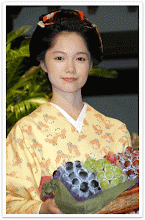
In 1940, he was shown films of using germ warfare in China that outraged him enough to force his brother the Showa Emperor top watch it. After the war he opposed After the war the Prince spoke before the Privy Council strongly urging the Showa Emperor to abdicate and take responsibility for the war. While the Prince is still seen as a controversial figure in China, one must give him credit for speaking up to what Japan's forces in China had done. While much of Prince Mikasa's wartime history is disputed in China, he became a figure for peace in the post war years. Men who have seen the horrors of war tend to do this and the Prince was no exception. He would go on to pursue academia in Tokyo University and is noted for his Middle Eastern Studies. On 2 December 2015, Prince Mikasa became the first member of the imperial family to live to 100. On his 100th birthday, he was quoted as saying: "Nothing will change just because I turn 100 years old. I'd like to spend my days pleasantly and peacefully while praying for the happiness of people around the world and thanking my wife, Yuriko, who has been supporting me for more than 70 years." He spent his final moments with his wife Princess Yuriko Mikasa (seen in photo below). It is said he outlived all of his siblings and all three of his sons.
We at American Mishima wish the Prince peace and farewell.
As we have been working on publishing
an illustrated a book and a epic Samurai Novel, we haven't had the
time to review any films lately and we do apologize for that. So in
doing so we thought this film review was worthy of mention. Earlier
this year we reviewed the 2012 film “Emperor” which depicted the
American Occupiers post war investigation as to the Showa Emperor's
role in the war. In our research we discovered an earlier Russian
film which also depicted the late Showa Emperor in the same period of the closing days of WWII in the 2005 film titled
“The Sun” directed by Aleksandr Sokurov'. While Sokurov' contends
he is not interested in Politics, the stark difference between
Emperor and The Sun become quite clear.
The Sun features Ogata Issei in the
starring role as the Showa Emperor Hirohito. In this film we see a
very different Showa Emperor cloistered in the isolation and
claustrophobia of his underground wartime bunker. While conditions
inside the Imperial Bunker are not so much like the Führerbunker
in Berlin, the mood is equally grim.
Here we see a rather frail looking
Showa Emperor meeting with his wartime Ministers in Military uniform
for the last time. As depicted in other films, ministers
representing the rival Army and Navy bicker over who has lost the
war. The Emperor seems powerless to control the ensuing debacle and
escapes his air raid shelter to study marine biology as a mental health distraction
while Tokyo is under constant bombardment. Unlike Hitler, the Showa
Emperor is portrayed as being somewhat childlike and lost consuming himself in Tanka poems of his grandfather the Late Meiji Emperor and other philosophical pursuits. While he does accept personal blame, he does acknowledge his own limited power to stop his ministers from going to war and the arrogance that in turn lost the war.
While it is anyone's guess here in the
West as to how he the late Hirohito felt about his divinity, The Sun
depicts his divine status as a burden which he is happy to be rid of.
History recalls this was an imposed condition of Japan's
Capitulation. As the film continues on, we have no visible time line
between the closing days of the war and the post war Occupation. In
fact, you can never tell when this film is going to become dramatic
or going to end. One moment, air raid sirens scream in the background
while we are given an artsy depiction of angry fish replacing enemy
bombers incinerating the capitol.
The next thing you know there are
American soldiers on the Imperial Palace Grounds treating the IHA
staff and the Emperor himself with a total lack of respect. Save for
one Nisei Warrant Officer (played by Georgi Pitskhelauri ) who serves
as MacArthur's translator who bows and addresses the Emperor with
dignity, the rest of the troops mock the Japanese. While it is likely
possible that such disrespect may have taken place during the
American Occupation, it's hard to imagine seeing the Showa Emperor
being taunted by common American foot soldiers from Alabama during a
photo session being called Charlie Chan.
Straying further from history, there is
no mention of General Bonner Fellers who in Emperor leads the
investigation into the Emperor's Wartime Role. In “The Sun” we
have General MacArthur (played by Robert Dawson) leading the
investigation himself in a series of personal meetings where he
grills the Emperor in an antagonistic manner in English and somewhat with contempt. We of course had a problem with this. Whatever MacArthur's private notions might have been, he is recorded as treating the late Showa Emperor with dignity and respect not found in this film. Sorry Robert Dawson, but Tommy Lee Jones played the role with more character.
History
recalls that MacArthur did meet with him eleven times and did so as
respect as he saw him as a living unifying symbol of Japan. In
contrast, the film depicts the Showa Emperor as a frail, nervous, and
somewhat lost in his own sense of dimension. Clearly, if there was
some truth to it the Imperial Household Agency would have objected to
letting the public see this private side that robbed the late Emperor
of his dignity. An actor can only work with the script given to him.
And while we can not blame Ogata for the role we can question the
writing of this picture. For our money, we recommend you pass on this
film and see Emperor.
If you would like to see The Sun for yourself, it is available on Netflix for rental.
67 years have passed since the end of the Great Pacific War. And while many big blockbuster war films have been made both here in and in Japan, the early days of the American Occupation following Japan's catastrophic defeat have largely been unexplored or seen by American audiences. Until Now.
American Mishima has been privileged on behalf of Cultural News of Little Tokyo to screen the 2012 Lions Gate film Emperor. The full length feature film tells a fictionalized account based on the real life story of US Army Brigadier General Bonner Frank Fellers and his mostly overlooked historic role in Japan's path to democracy. Fellers (played by Mathew Fox star of ABC's Lost) who served under US Allied Supreme Commander General Douglas MacArthur (played by veteran actor & Oscar nominee Tommy Lee Jones) is given the impossible task to investigate the Showa Emperor's role in the lead up to war and most notably his majesty's alleged involvement the decision to attack Pearl Harbor within ten days.
Fellers recommendation to General MacArthur has Japan's entire post war fate in wrested in his hands. This is a great responsibility to which Fellers, a known Japan affectionado who had spent time in Japan before the war must handle delicately.
Fellers must question the accused Class A War Criminals such as Wartime Prime Minister Hideki Tojo.
And the Lord Keeper of the Privy Seal Koichi Kido (played by Ibu Masato ).
And former Prime Minister Prince Fumimaro Konoe (played by Nakamura Masatoshi).
None of these three men offer any satisfactory information or any real cooperation with Fellers investigation. Only contradictions in a land full of contradictions. Fellers frustration is not does not convince these former power holders that the Emperor's life is on the line nor do they understand the implications or have considered the consequences from their lack of cooperation.
As if Fellers had enough on his plate he must also deal with prejudice from both the resentful populace.
And soldiers within Mac Arthur's own Occupation Forces under his command. Complicating this task is the fictional General Richter (played by Colin Moy).
General Richter will use any underhanded means to derail Fellers investigation in order to justify revenge upon the Japanese Emperor.
Richter makes no secrets about his feelings. It's clear to Fellers what Richter is up to when Richter suggests MacArthur himself is setting Fellers up for a fall. His thinly veiled motives are quite clear as Richter conveys the American Public's demand for revenge while treating Fellers with suspicion if not subtle contempt.
“Revenge is not Justice” argues Fellers. And in that quest to exonerate his majesty, Fellers is assisted by Takahashi (played by Haneda Masayoshi) who is assigned to him as both interpreter and driver. This is a solemn task for a man who lost his wife and family in the first Tokyo raids and one he serves diligently without reservation.
Takahashi is initially treated with cold indifference by Fellers who seems to be both under the strain of his investigation and his anger over the war but it is soon revealed where poetic license with history ensues tin which Fellers is privately preoccupied with finding his Pre-War Japanese love interest Aya Shimada (played by Hatsune Eriko).
Takahashi must sift through the bombed out ruins of her last known address. This subplot takes us back to the 1930's where their accidental love story takes place. It is here that Fellers initial icy veneer of grim determination is stripped away revealing a warm compassionate gentleman who falls for a visiting female Japanese student attending his university.
Their budding romance is temporarily interrupted when Aya unexpectedly returns to Japan at behest of her ailing father who had taken ill.
Undaunted, Bonner Fellers gets an assignment in the Philippines where he takes advantage of his position and takes an extended leave to follow Aya in Japan but to his surprise, he is not warmly received.
Her late father forbid her to be with a Gaijin as Anti-foreigner sentiments loomed with the pre-war Army propaganda being circulated to school children as evident by the rocks thrown at Fellers.
It is through Aya that we are introduced to her uncle General Kajima (played by Nishida Toshiyuki of Ramen Girl). Kajima is a robust Army General who had spent two years in the United States before the war but in contrast to the real life Japanese Officers who actually visited the United States and opposed such an unwinnable war, he sincerely believes Japan could win an armed conflict with the United States. Despite his initial distrust, he offers Fellers both traditional Japanese hospitality and assistance in understanding the mindset of the Japanese Soldier. This experience will stay with him throughout his investigation.
As MacArthur's Washington imposed deadline looms, Fellers requests more time but is swiftly denied. MacArthur orders Fellers to go to the Imperial Palace and demand to speak with the Lord Keeper of the Privy Seal Koichi Kido who had previously refused to meet him in secret.
Faced with armed sword bearing Imperial Palace Guards, Fellers demands an audience which is politely re-translated by Takahashi in terms that are far less menacing granting only Fellers access to Kido while his armed squad awaits his return outside the palace gates.
With expectations running high and little time remaining, Kido offers no evidence implicating or exonerating the Emperor that would clear the reigning monarch. Instead Kido offers one instance of the Emperor's involvement with the Army controlled military government three months before the attack on Pearl Harbor where the Emperor made an unprecedented move entering the Supreme War Council to offer a simple yet heavily weighed Tanka Poem (An Emperor's most commonly used device in Japanese Taiga Dramas) written by his grandfather, the late Emperor Meiji: “If the worlds oceans be joined in peace, Why does the world rise in raging waves?”
But when all hope seems lost, a major break comes Fellers way. In the middle of a late night Tokyo rain storm that Bonner Fellers would have a most auspicious visit by none other than one of the most sought after men wanted by the American authorities; General Sekiya Teizaburo (played by Natsuyagi Isao of Ten to Chi to aka- Heaven & Earth 1990).
Like Koichi Kido before him Teizaburo Sekiya offers no concrete proof of the Emperor's complicity or innocence yet offers a detailed account of the events leading to his majesty's famous recording heard throughout the embattled empire where the Emperor asked of his military and his people “To endure the unendurable.” It is a most remarkable scene that vividly depicts in full color the extent of the brutal assault by Imperial Japanese Army troops upon the Imperial Palace itself, an unprecedented violent move to prevent the Emperor's broadcast announcing Japan's defeat without uttering the word Surrender by fanatics who wished to continue the futile fight to the bitter end. Not since the 1967 film Nihon no ichiban nagai hi -aka Japan's Longest Day starring the legendary Mifune Toshiro had anyone depicted such treacherous mutiny by the army upon the Chrysanthemum Throne and the valiant efforts by the palace guard and Imperial Household to protect the Emperors words.
It is with accounts of the Showa Emperors actions during the assault on the Imperial Palace to ensure that Japan would agree to end the war that give Fellers a plan of action that would determine both the Emperor and Japan's Post War fate.
Emperor has a few well done CGI effects such as the aerial shots of MacArthur's transport plane and the American naval ships in Tokyo Bay that help recreate the world of Post War Japan. Attention to detail was given to the costume design and overall art direction.
Throughout the movie there are notable performances from Mathew Fox & Hatsune Eriko, and most particularly that of Tommy Lee Jones who he admittedly looks nothing like the real General MacArthur.
But once in the period uniform, officers hat, aviator sunglasses, and that famous corn cob pipe dangling from his mouth, Jones visually assumes MacArthur's larger than life persona of the legendary Supreme Allied Commander but if you close your eyes for just a moment he still sounds like Agent K from Men in Black. “Allright!” While Jones's own personality has his own powerful, he is perfectly suited for playing the role of the confident Douglas MacArthur, a general who sought to make history by having the most successful bloodless occupation but whose grandstanding for the press and ego would overshadow his historic accomplishments and contributions to the rebuilding of Japan. Eventually this would get him fired by President Truman during the Korean War.
Without giving away any more of the film, the realistic looking sets and locations depicting the beautiful traditional serene washitsu styled homes of Konoe and Kajima contrast the bleak fire bombed devastation of twisted metal and charred ruins of Post War Tokyo recreated in Auckland are both reminiscent and relevant to the recent Tohoku tragedy of our times.
In conclusion, it is often darkest before the dawn and throughout history such tragedies are overcome by a people's will to rebuild.
Like the humble words of the current Heisei Emperor in the wake of the Tohoku tragedy so too are moving words of the Showa Emperor (played by Kataoka Takataro of Empire of the Sun) whose performance and stunning likeness brings the late monarch back to life.
Though Takataro's scenes are brief, they are profound as they are moving. Takataro's performance convey both the dignity and presence of this most humble and yet misunderstood vilified controversial monarch. While some Americans who bear historical grievances may pass on the film or view with prejudice, we found this drama both revealing and true to the spirit of those times offering hope in the wake of tragedy. Like the overall plot this film, Emperor carries it's redeeming qualities that is both respectful to Japanese Culture and true to human nature. For the Showa Emperor's pivotal scene alone, we will give this film high marks and sincere gratitude to the filmmaker Peter Webber and writers David Klass & Vera Blasi for bringing this most important overlooked story to the big screen.
Seen here is the real non-Imperial sanctioned photograph of the Showa Emperor's historic meeting with the US Allied Supreme Commander General Douglas MacArthur.
Finally! An alternative Japanese band I can halfway relate to! I mean seriously, I literally pain myself to like some of the Visual Kei & Goth bands that come out of Japan. With the exception of the Yoshida Brothers, I am left with bands that look amazing but sound too techno or too deathmetal. My years of Goth Culture and early Punk Rock have me demanding much more from Japan. These guys on the other hand break from the usual J-mold of having too much talent and no set direction. Luckily, I discovered The Seppuku Pistols on line almost by accident. I was like なに?? すごいい!!! I had grown up on Punk Rock and The Sex Pistols when I was younger so this was a natural winner for me. This has got to be the best use of Yukio Mishima footage since Paul Schraeder's film of Mishima - Life in Four Chapters. As a fan of Yukio Mishima I found this quite amusing. This is more or less a noise remix of the Pistols with Yukio Mishima mixed in. The Seppuku Pistols bring out angst in an artistic way reminiscent of what Laibach did in Europe in the early 1990's mixing industrial noize with war time imagery. In general, I do like their use of old Johnny Rotten samples mixed in with images from the Showa Era. So love it, hate it, or just be punk rock and drink sake to it - either way it's The Seppuku Pistols!
“American Mishima” is the work of Louis Rosas, the son of Mexican Immigrants, whose father served in Vietnam for the US Army and who grew up on glamorized war films and military aviation in the sleepy seaside plains of Oxnard, Calif. With an early fascination of the Second World War embedded in his young mind during the post-Vietnam era, it was his exposure to Akira Kurosawa's samurai epic Ran (Toho, 1985) that changed his views of war while creating a lasting impression of Japanese culture and history. Further inspired by the works of Japanese writer Yukio Mishima, Rosas would go on to study Japanese language and swordsmanship, which led him to the practice of Shingon Buddhism and Shinto. Rosas is also a former student of Shinkendo, the ideal and practice of the samurai code of Bushido in the modern world, which helped shape the creative force that is “American Mishima.”


 Posts
Posts