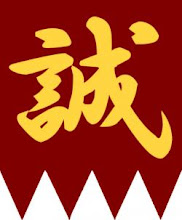
After 72 years since the end of World War Two, the flag that once flew on the flagship of the Combined Fleet the IJN Nagato has been retruned home to Japan. This was once the flag of Admiral Isoroku Yamamoto that was taken from the ship after Japan's unconditional surrender in 1945. The Nagato itself was later used as part of the fleet of ships at Bikini Atol after the war. The once proud ship was built so tough, it withstood two atomic bomb blasts before having to be sunk by torpeedo as seen in the photo below.
Going back to Nagato's ensign, the flag had been in storage and was presented by the president and chief executive officer of the USS Missouri Memorial Association in Hawaii Machael Carr to the musuem dedicated to Admiral Yamamoto in his home city of Nagaoka Japan. NHK reported that the musuem cheif Satoshi Maruyama was moved by touching the flag. We at American Mishima appreciate this gesture of good will on the part of the USS Missouri Memorial Association. It is in our opinion, this is another long overdue another jesture of peace and closure to the Showa Era. May her spirit and the memory of the Nagato that carried her live on!
Seen here is veteran actor Haruo Nakajima. We by chance came across his unique story through a WWII forum and found it fascinating enough to share with you here. You see, Haruo
Nakajima was conscripted into the IJN at the age of 14. He
served as a gunner on a Mitsubishi G4M"Betty" Bomber, and somehow miraculously survived an encounter
with a Grumman F6FHellcat.Mr. Nakajima is said to have attended Admiral Yamamoto's funeral. If surviving the Hellcat wasn't enough he just happened to be
flying on the day that his new ship, the "Shinano" was sunk with 1500 men going down with her. If not for the war's end, he would
have been assigned to suicide missions on Shinyo suicide boats. Nearly
all of his classmates from training had died on such missions. Somebody was definitely looking out for this man!
Mr. Nakajima would later become famous when he won the role of Godzilla
in 1954. He played the iconic character until 1972, when he retired. He is also known for his work on Akira Kurosawa's Seven Samurai and recently appeared in Steve Okazaki's Documentary MIFUNE THE LAST SUAMURAI. Mr.
Nakajima is now 88 years old still counting his lucky stars! How awesome is that? すごいい!!!
This years AFI Film Festival had a much anticipate treat for fans of the late Japanese Film Legend Toshiro Mifune with the the debut screening of MIFUNE: The Last Samurai. Directed by Oscar Winning Director Steve Okazaki who grew up watching Samurai Films starring Mifune here in Los Angeles on a bed sheet at a Japanese Community Center. As quoted by the director himself, he thought this was going to be great to go through old film clips but it turned out to be more than anticipated. You could say this documentary was more than a labor of love. We would say it was a unique insight to the origin of Samurai Film recounting the golden age of Japanese Silent films.
Those early films now mostly lost to time and war were initially based on Japanese Noh plays and later became known as "Chambara" films. The word "Chambara" comes from the sounds of clashing swords in film making. Up until Mifune entered his near accidental career, Japanese Samurai films were at best predictable and very formulaic. Enter fate. It was at the outbreak of war with China that young Manchurian born & raised Toshiro Mifune was conscripted into the Imperial Japanese Army and sent to Japan for the first time. Like many conscripts, he was mercilessly beaten by his superiors for his rebellious attitude.
Mifune later is assigned as an Aerial Photographer. Being that his father was a studio photographer who often used him as a model. At some point in World War II he was taken off flight status and assigned to a crew chief position for the Kamikaze. This is where the documentary gets deep. Director Steve Okazaki reveals in his film with the help of interviews from both family and former cast & crews that knew him that his role in the war was to see the young pilots off before their desperate suicide missions. He would tell them: "Don't say you are doing this for the Emperor. Say good bye to your mothers. Now off you go." This may have played a role in his heavy drinking after the war. It was said by his family that when the war came up he would break down in tears. One can only imagine the faces of the young pilots he unwillingly was tasked to send to their deaths. It was clear in his eyes when he played Admiral Yamamoto in Tora Tora Tora this sense of guilt and burden he carried.
Like many returning soldiers returning to Japan after the war's end, Mifune sought to find work in Tokyo. Being that he had been a photographer, he applied at Toho Studios. But for some reason his application was submitted for an acting position instead of the photographer position he had wanted. He failed miserably and became enraged. Lucky for us that legendary director Akira Kurosawa saw something in him and cast him for his early post war films. It would not be until after 1950 when the American Occupation ban on films made with swords that the most iconic Samurai film of all time directed by Kurosawa starred Mifune in The Seven Samurai.
Seven Samurai became an international hit and back home in Japan it redefined Samurai film. No longer were "Chambara" films made. Rather, films explored what became known in the West as "The Anti-Hero." Mifune's presence was so large, he would star in many films with Kurosawa such as Rashomon, Throne of Blood, Yojimbo, Sanjuro, Red Beard, and The Hidden Fortress which became the inspiration for Star Wars. This documentary contains a literal who's who of Japanese acting greats and former crews who worked with Mifune. They got everybody they could find but Tatsuya Nakadai. Trust me, we asked! We feel that as far as documentary films go, Steve Okazaki has presented Mifune fans a real treat. Just seeing film clips from the Samurai Trilogy on the big screen makes you want to leap out of your seat with excitement and joy that only a Mifune film could inspire. This film which surprisingly is narrated by Keanu Reeves (Whoa!) is a must for any Toshiro Mifune fan. We at American Mishima congratulate Director Steve Okazaki for this cinematic delight! That beinbg said, we have to let you know that this will be screened on limited release in December 2016 in Los Angeles, San Francisco, and New York City. If you can not see this in those cities, we recommend you look out for it when it becomes available on Amazon or Netflix. Please Enjoy!
There have been many cases since the end of the Second World War where the children of Veterans discover old war treasures and choose to return such items to history. For the Hartman family of Robert Hartman who served in the US Navy during WWII, such a treasure had been kept in their possession. It had been taken by Robert Hartman when the US took possession of the Nagato. What they had was the Admiral's flag of the IJN Battleship Nagato which served as Admiral Isoroku's Flagship during the attack on Pearl Harbor. It was said the flag was used by the family as a blanket years ago but after Mr. Hartman passed away, his daughter Dianne Hall having realized the historical significance of this flag choose to donate the flag to the US Park Service (which oversees the care of the Pearl Harbor Visitors Center) so that it will honor the veterans who fought on that day. The Park Service says it will seek to preserve the flag for future generations. No word on when it will be on display but know that it is in safe keeping.
As seen in the photo above is the last known image of Admiral Isoroku Yamamoto of the Imperial Japanese Navy taken hours before his doomed flight would be intercepted by American P-38 Lightning fighter interceptors. It has been often theorized that the Imperial Japanese Army bungled the message carrying his itinerary over an open code that tipped off the Americans where the head of the Imperial Japanese Navy would be next. Despite the desperate urging of the Army commanders to call off the flight and knowing his itinerary had been compromised, the Admiral chose to continue with minimal fighter escort. A decision some would say ended Japan's hopes of settling for peace with the United States. A peace that would only come after two more years of deadly war ending in Japan's catastrophic defeat. Whatever really happened, the reluctant admiral ( and we say this knowing he openly opposed the war with the United States ) perished with his staff and flight crew of the Mitsubishi GM4 "Betty" bomber that carried him into history on April 18th, 1943.
We thought much of the Admiral who was featured in the 2012 movie by the same name as we looked upon the solemn display recreating the wreckage that killed the best of Japan's Naval Leadership. The broken wreckage sits silently in a hanger in Chino recreating what one would have seen had they sifted through the thick jungle to recover the bodies of those aboard. While we have read many Blog Posts about this display with a degree of post war prejudice, we did not find it there. Rather, the display sits without any gloating or war time propaganda. It sits like a silent memorial to lives lost to a moment of time. As most wartime aviators will tell you, it was war and war is often impersonal ugly business. It is a sad reminder that there are human costs to war. The consequences of such which few can understand who have not seen combat. We appreciate the Planes of Fame Air Museum for recreating this display with a manner of dignity and respect. While we are not here to re-fight WWII, it is our hope that such a war will never happen again.
American Mishima has been proud to continue this series based on the Military Channel's An Officer and a Movie to bring you the films and profiles of Real Japanese Officers and the Movies that featured them. In continuation with this series we are happy to present to you what we believe is the most important film that has ever come out of Japan – the Big Budget 2011 Toei Company's “The Admiral” - A film that not only tells the untold truth behind the Pacific War but of the man who opposed it who was ultimately forced to conduct it with absolutely no hope of winning.
In America, the great Pacific War of WWII is simply summed up with 'The Japs bombed Pearl Harbor then we bombed Hiroshima – enough said.” This pervasive attitude is not only an oversimplification but demonstrates a total ignorance of what took place during this war and how little Americans know of the Japanese who our country was fighting or why this war even took place in the first place. With the brief notable exception of 2001 Michael Bay film Pearl Harbor no such film has ever tried to adequately explain why Japan went to war with the United States or who fought on Japan's side. 2011's Toei Company The Admiral does just that.
So who is this enigmatic Admiral? Yamamoto Isoroku! When one thinks of Admiral Yamamoto, the best image that comes to mind comes from the final scene in 1971's Tora Tora Tora where Yamamoto played by Sō Yamamura declares “We have only wakened a sleeping giant.” For most that is their only impression of this great man. But who was he really? Yamamoto Isoroku was born of Samurai lineage in 1884 in Nagaoka, a village that fought for the Shogunate during the Boshin War. He was a graduate of the Imperial Japanese Naval Academy in 1904 and would go on to serve aboard the cruiser Nisshin during the Japan-Russo War where he would lose his middle and index fingers on his left hand as the Nisshin hit the Russian battle line. After the war he returned to the Naval Staff College in 1914 and made Lieutenant Commander by 1916 about the time he met his wife Reiko Mihashi who would bear him two sons and two daughters.
From almost the outset of the 1920's Yamamoto Isoroku had become a well known fixture in the Naval establishment who supported gunboat diplomacy through a strong Navy. This of course made him many enemies within the Army which in the film depicts many of the rivalries going back to unsettled grudges from the Boshin War. Unlike many of the wartime leaders, Yamamoto Isoroku had the fortune to study at Harvard (1919-1921) and have two postings as Naval Attache in Washington DC. He became very fluent in English and understood America well. He became a strong advocate for Naval Aviation for like his disgraced American contemporary Billy Mitchel believed the age of the Battleship was over. Being such a proponent made him the target of many assassination attempts which became public after he opposed Japan's proposed signing of the Tripartite Pact with Nazi Germany and Fascist Italy. He believed this did not serve Japan's better interests and he was right. But we'll get into that later as we talk more about the movie.
You see, unlike his rivals in the Army who pushed for war with America, he opposed it. Yamamoto Isoroku understood the great industrial output America had compared to Japan's meager building capacity. With both demotion or assassination remaining a constant threat, he chose his words in opposition cautiously. “I would not dare invade America for there would be a gun behind every blade of grass,” reads one famous quote. Another quote: “I wonder if our politicians (who speak so lightly of a Japanese-American war) have confidence as to the final outcome and are prepared to make the necessary sacrifices.” Such a war could only lead to catastrophe. Yet in the grim hopes of stalling for time there was a faint hope that if diplomacy failed one heavy blow to the US Navy could open a position in which to sue for peace. Once it started, he knew this would not be possible. While the press back in Japan touted the Pearl Harbor bombings as a great victory, Yamamoto Isoroku's pessimistic predictions of disaster echoed with the air raid sirens sounding Doolittle's Tokyo Raid.
As seen here, this was the last image of the Admiral before his fateful flight. Yamamoto Isoroku had always hoped Japan could sue for peace something only he believed could do but would never live to see it as his plane was jumped by a flight of P-38 Lightnings who had been given his exact itinerary that was foolishly or deliberately transmitted by the Army in the open frequency announcing where he would be. Admiral Yamamoto Isoroku died April 18th 1943. The exact details of his violent death was kept hidden from the public. He was given a state funeral the following month.
So onto the movie which starts with a young Isoroku watching his town of Nagaoka burn in flames he is told the story of his 71 year old grandfather who made his last stand drawing his sword against Satsuma during the Boshin War. From this point on the entire movie is told from the perspective of a Tokyo based reporter named Shindo Toshikazu (played by Tamaki Hiroshi) who is tasked to interview Admiral Yamamoto Isoroku (played by Yakusho Koji) under the watchful eye of his nationalistic boss Munakata Keikiyoshi (played by Kagawa Teruyuki) and cover Admiral Yamamoto Isoroku's career.
The Admiral is anything but what Shindo expected. He is openly opposed to a War with America and further believes Japan could not win. Munakata argues that Russia was also big and powerful yet lost to Japan. Of course the Admiral counters with "They were weak and the in the midst of Revolution. You could not easily sweep America aside. To wage such a war would mean total war will not end until one country is reduced to ashes." This of course enrages Munakata and storms out of the interview. But it is Shindo who keeps an open mind which Yamamoto Isoroku sees clearly. Such a complex man yet so unpopular with the masses all buying into the Army's propaganda. What people in America are unaware of is during the early Showa Period there were three Military Coup detat's in Japan. With the Army in control, the Navy was always under threat. Shindo realizes that the inner circles of power were made up of men from Satsuma & Choshu still engaged in never ending fighting with Nagaoka in the Boshin War.
While the public is happy to have a law and order restored under Prime Minister Tojo who is looking to join hands with Adolf Hitler, Yamamoto Isoroku and much of the Naval Staff are opposed to the Tripartite Pact with Germany and Italy for they have read the uncensored version of Mein Kampf and unlike the public who adores Hitler are unaware of Chapter 13 where Hitler talks about using the Asiatic people to serve Germany. In one scene a fellow Officer who quotes Hitler's censored chapter to three young arrogant officers demanding to support the pact, Yamamoto asks "How do you like your friend Hitler now?"
All is not what it seems in Japan. The truth is hidden from the public in an effort to support the Army Controlled Military Government of Tojo and their alliance with Nazi Germany. In an effort to get Yamamoto Isoroku out of the way he is ordered out to sea. A safe demotion as they called it but ultimately it forces him to light the very match to the flames of war he so vigorously opposes. His faint hope is that if one knock out blow to the US Navy can be achieved then they could sue for peace. It was a hope he knew was a near impossibility. Yet under pressure, he was forced to take command of the fleet and carry out the attack on Pearl Harbor.
At first the attack is viewed as a success. But with the reports of no aircraft carriers in port has the Admiral cautious. But when it is revealed that the Japanese Embassy bungled the delivery of the Declaration of War by announcing it thirty minutes late after the attack at Pearl Harbor commenced, Yamamoto concluded that Japan had now committed itself to a path of destruction with little hope of any chance to sue for peace given.
As history recorded, Admiral Yamamoto halted all further attacks on Pearl Harbor and returned his fleet to port. He did not see the attack as a victory but the embarkation of the a great unmitigated military disaster that could only end in Japan being reduced to ashes. Upon arrival, they were greeted as heroes but the celebration is short lived as the air raid sirens are heard over Tokyo as Jimmy Doolittle's raid bombs the capitol.
In this film we are given insights into his relationship with his family and his brother.
His own sister who still farmed in Nagaoka is greeted with praise for her family's honorable son. Such affection warms his stark cabin aboard the Battleship Nagato.
But you naval buffs won't be cut short there! Check out these dream shots of the carrier Agaki
Carrier Hiryu
Battleship Nagato
And my personal favorite the Battleship Yamato!
What is great is you see new re-imagined views of the Battleship Yamato not seen in the film Otoko Tachi no Yamato. But the War doesn't end at Pearl Harbor. We are next taken to the disaster known as The Battle of Midway.
Using the same planner of the Pearl Harbor attack Kuroshima Kameto (played by Shiina Kippei), Admiral Yamamoto approves the plans to for the assault on Midway Island in hopes of establishing a forward operating base to keep America away from Japan's Empire. He will do this by entrusting the fleet to Admiral Nagumo Chuichi (played by Nakahara Takeo).
But from the start, the operation goes against Japan. Nagumo's tactical blunders costs him all four aircraft carriers and the bulk of the combined fleet.
It is the pilots of the Hiryu who throw everything at the US Navy who score their only damage to US Carriers but it comes at a high cost in both well trained men and machinery.
In the end, it is Admiral Nagumo who comes to apologize to Admiral Yamamoto who asks him to join him for soup. To me this is a poignant scene where two men share a moment of humanity as one consoles another in their defeat. Nagumo is both ashamed of failure but more so humbled by Yamamoto Isoroku's understanding, Admiral Nagumo breaks down and weeps.
Meanwhile back in Tokyo, Shindo is told to report the war as he is told to omitting the truth that Japan is losing. Instead of using the word retreat, they are told to report that units are being transferred.
Shindo is bothered deeply by this prospect and thinks back to the Admiral's gloomy predictions of what war would bring to Japan.
As the war wages on there are few hopes left that Admiral Yamamoto could sue for peace. While visiting front lines, he chose to visit the Army who foolishly or deliberately transmits his itinerary on open frequency that results in the most tragic consequences.
On April 18th 1943, Admiral Yamamoto Isoroku's plane is jumped by a flight of American P-38's armed with 50 caliber machine guns and the knowledge of the Admiral's flight. The news of his death is a shock to the nation. A clear indication that Japan's hope for victory was now an impossibility with more and more men being called up to serve including Shindo.
We can not emphasize how important this film is. It is easy for any arm chair historians to say "well if he opposed the war so much why did he fight it?" There is no simple answer to such an simplified assessment of the war or the man that Yamamoto Isoroku was without being halfway knowledgeable of Japanese Culture and History dating back to the Arrival of the Commodore Perry's Black Ships in 1853. It is so sad that this film is not playing in major theaters in America for this film provides the ultimate history lesson as to why Japan ever fought the United States.
We have read other blogs and Japanese papers who have printed many negative comments by people who are largely anti-Japanese and who have never seen the film. We won't allow negative comments here and luckily for us we have never had any. As pro-Japan we are here we do not make excuses for Japan's Wartime past but acknowledge it as we do those who fought it and those who opposed it. We wish that war never happened and had military leaders had listened to Admiral Yamamoto it is possible the war could have been avoided as it should have. None the less, there is no further debate. This film regardless of your feelings about the war tells what really happened on the other side and that of one remarkable man. If we were to recommend only one film to explain this war this would be it. But don't just take my word for it. See it for yourself!
“American Mishima” is the work of Louis Rosas, the son of Mexican Immigrants, whose father served in Vietnam for the US Army and who grew up on glamorized war films and military aviation in the sleepy seaside plains of Oxnard, Calif. With an early fascination of the Second World War embedded in his young mind during the post-Vietnam era, it was his exposure to Akira Kurosawa's samurai epic Ran (Toho, 1985) that changed his views of war while creating a lasting impression of Japanese culture and history. Further inspired by the works of Japanese writer Yukio Mishima, Rosas would go on to study Japanese language and swordsmanship, which led him to the practice of Shingon Buddhism and Shinto. Rosas is also a former student of Shinkendo, the ideal and practice of the samurai code of Bushido in the modern world, which helped shape the creative force that is “American Mishima.”


 Posts