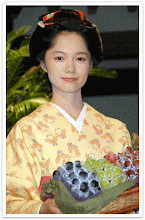
Famed comedic actress Kirin Kiki passed away at her home this September 15th, 2018. She had been battling cancer and had recently undergone a mastectomy. Born during the war in 1943, Ms. Kirin Kiki has had a long career both in film and television. For us, she will always be best known for her portrayal as the wonderfully delusional Miss Orin in Sonny Chiba's Kage no Gunden aka Shadow Warriors. Since that time, she had played the aging grandmother in recent films such as Kamikaze Girls. She appeared with her granddaughter in Sweet Bean and made her final film Shoplifters in 2018. She was diagnosed with cancer in 2004 and was recently quoted as saying that "Cancer had spread throughout her entire body," something in her final years had come to accept. She had great comedic timing and played many colorful characters, but for us, she will always be Miss Orin chasing Mr. Han. She will always be remembered in film and in our hearts. Sayonara Kirin Kiki, Sayonara.
This years AFI Film Festival had a much anticipate treat for fans of the late Japanese Film Legend Toshiro Mifune with the the debut screening of MIFUNE: The Last Samurai. Directed by Oscar Winning Director Steve Okazaki who grew up watching Samurai Films starring Mifune here in Los Angeles on a bed sheet at a Japanese Community Center. As quoted by the director himself, he thought this was going to be great to go through old film clips but it turned out to be more than anticipated. You could say this documentary was more than a labor of love. We would say it was a unique insight to the origin of Samurai Film recounting the golden age of Japanese Silent films.
Those early films now mostly lost to time and war were initially based on Japanese Noh plays and later became known as "Chambara" films. The word "Chambara" comes from the sounds of clashing swords in film making. Up until Mifune entered his near accidental career, Japanese Samurai films were at best predictable and very formulaic. Enter fate. It was at the outbreak of war with China that young Manchurian born & raised Toshiro Mifune was conscripted into the Imperial Japanese Army and sent to Japan for the first time. Like many conscripts, he was mercilessly beaten by his superiors for his rebellious attitude.
Mifune later is assigned as an Aerial Photographer. Being that his father was a studio photographer who often used him as a model. At some point in World War II he was taken off flight status and assigned to a crew chief position for the Kamikaze. This is where the documentary gets deep. Director Steve Okazaki reveals in his film with the help of interviews from both family and former cast & crews that knew him that his role in the war was to see the young pilots off before their desperate suicide missions. He would tell them: "Don't say you are doing this for the Emperor. Say good bye to your mothers. Now off you go." This may have played a role in his heavy drinking after the war. It was said by his family that when the war came up he would break down in tears. One can only imagine the faces of the young pilots he unwillingly was tasked to send to their deaths. It was clear in his eyes when he played Admiral Yamamoto in Tora Tora Tora this sense of guilt and burden he carried.
Like many returning soldiers returning to Japan after the war's end, Mifune sought to find work in Tokyo. Being that he had been a photographer, he applied at Toho Studios. But for some reason his application was submitted for an acting position instead of the photographer position he had wanted. He failed miserably and became enraged. Lucky for us that legendary director Akira Kurosawa saw something in him and cast him for his early post war films. It would not be until after 1950 when the American Occupation ban on films made with swords that the most iconic Samurai film of all time directed by Kurosawa starred Mifune in The Seven Samurai.
Seven Samurai became an international hit and back home in Japan it redefined Samurai film. No longer were "Chambara" films made. Rather, films explored what became known in the West as "The Anti-Hero." Mifune's presence was so large, he would star in many films with Kurosawa such as Rashomon, Throne of Blood, Yojimbo, Sanjuro, Red Beard, and The Hidden Fortress which became the inspiration for Star Wars. This documentary contains a literal who's who of Japanese acting greats and former crews who worked with Mifune. They got everybody they could find but Tatsuya Nakadai. Trust me, we asked! We feel that as far as documentary films go, Steve Okazaki has presented Mifune fans a real treat. Just seeing film clips from the Samurai Trilogy on the big screen makes you want to leap out of your seat with excitement and joy that only a Mifune film could inspire. This film which surprisingly is narrated by Keanu Reeves (Whoa!) is a must for any Toshiro Mifune fan. We at American Mishima congratulate Director Steve Okazaki for this cinematic delight! That beinbg said, we have to let you know that this will be screened on limited release in December 2016 in Los Angeles, San Francisco, and New York City. If you can not see this in those cities, we recommend you look out for it when it becomes available on Amazon or Netflix. Please Enjoy!
Last night we attended the 2016 AFI Film Festival screening of Studio Ghibli's The Red Turtle at the Egyptian Theater in Hollywood. This much anticipated film from Studio Ghibli was the first non-Japanese film they produced by Belgian-Dutch director/animator Michael Dudok de Wit in a French-Japanese collaboration. Right from the get go we are introduced to the sounds of a dreadful storm on the high seas where a shipwrecked man struggles to stay afloat in the walls of water of which only the strong can survive. Going into his you know this will be a story of survival and there will be hardships. Studio Ghibli founder Hayou Miyazaki loves powerful scenes of nature for his backdrops and for this project Dudok de Wit does deliver. So early on this film scores very high on a technical level with incredible hand drawn animation.
No sooner than our castaway acclimates to his new circumstances on a small uninhabited tropical island, he immediately seeks to escape it. You'll note that he makes no effort to build a shelter or collect rain water but does make a minor effort to find food. This struck us as odd. In order to escape an island, you'll need provisions and good preparation but our castaway makes none of these necessary steps for survival. Instead, he builds a raft and tries to escape with no delay. No sooner than he is into open waters, his raft is destroyed by a massive red sea turtle. The man has no choice but to return back to the island. He will make two more attempts to flee by raft but will be thwarted by the same turtle marooning him to his fate back on the island. Out of frustration, the man gives into despair and flights of fantasy. So far so good right?
Up until this point, Dudok de Wit's film is firing on all cylinders living up to the high standards that is Studio Ghibli's well earned reputation. You have nature, struggle, and the human condition following a well envisioned story arc audiences who grew up on Robinson Caruso or had seen Tom Hanks in Castaway will be well familiar with. But here is where the story goes into a direction we had trouble buying. As our castaway attempts to build his fourth raft to escape, the red turtle comes ashore. Out of rage, the man turns the turtle up onto his back and kills him. This we get. What we don't get is why a half starved man would not attempt to cook the turtle and eat it. This made no sense. Instead, he has a crisis of conscious and decides to administer water in hopes of reviving the dying turtle but it is too late. Prior to this we see the man suffering from hallucinations. The film only gives you partial clues that he is losing his mind. Now we find a woman lying unconscious in the shell of the turtle. At first there is an uncomfortable distance and then romance.
As time goes on, the man forms a bond with this mysterious woman who exchanges no dialog with him. They eventually have a son together and the find happiness on the island. You want desperately want to believe this. You want this film to work. This man has suffered so much you root for him and his little family. But in the end, it is all a lie and a third of the audience left before Dudok de Wit opened the floor for the post film Q&A. I was upset and wanted an answer so we stuck around. Dudok de Wit described getting that phone call from Studio Ghibli to produce a full feature film as a "Opportunity of a Lifetime." There we agree. But what he chose to do next looked like an ambitious animated film with powerful themes, excellent animation, and everything you would expect from a Studio Ghibli film only to be ruined by the conclusion of the story arc. Instead of giving you hope, Dudok de Wit gave you a pretentious French Art Film that left you feeling empty. In Dudok de Wit's own words, he did not have a story but a concept. So far so good. He described how the castaway theme has been popular over the last two centuries. Check. But instead of redemption he chose to bum us all out and go with a sad ending you had wished he had avoided. Only Rod Serling was able to successfully pull such a story line off in his remake of a short French Film on his Twilight Zone episode titled An Occurrence at Owl Creek Bridge. But there, you know it's all fantasy. It's a hard task to pull off and Dudok de Wit went this French Art Film route and potentially squandered an Opportunity of a Lifetime. We would have went with a different ending that gave both redemption and hope but American Mishima did not get the call from Studio Ghibli, Michael Dudok de Wit did so there you have it. Perhaps we are wrong about this bold experiment but this anger we woke up with the morning after says no. As we had previously mentioned, The Red Turtle scores highly on a technical level but fails us on a story level. Only you the audience will have final say at the box office. This has just been one man's review. We are sure Studio Ghibli will hope you'll be more generous But see it for yourself and then you decide.
As many people know, Japanese Jidaigeki Dramas of the Samurai period have been popular in Japan since the introduction of television. Throughout its history, many famous actors and stunt coordinators have perfected the art of sword play for the stage and screen. But like with any sword play whether it is for acting or for real Budo requires much training and coordination. As we say in America, there is a learning curve. Evidently last week, 33 year old actor Daigo Kashino fell on that curve and was rushed to a hospital for a wound he suffered during rehearsal with a prop sword. The wound is said to have pierced his abdomen during an action scene. This is the second death in recent times where a performance had gone wrong. An Italian actor chocked to death while doing a hanging scene. We don't know if this was a low budget film or just sloppy stunt coordination. Having worked on low budget films in our past we can tell you that some productions will try to cut every corner just to get a shot. We sure hope that was not the case. The sword is believed to be a practice sword and not a real katana. But still, even without a real edge, a 73cm blade of any object is not to be toyed with lightly, hence why in real Budo we bow and pay so much respect even for practice weapons. We at American Mishima hope that tragic scenes like this won't be repeated anytime soon. Speaking from personal experience; "When engaging in swordplay, even for the stage, one must always engage with absolute sincerity. Makoto!"
It's troubling when you hear of one of your favorite actors fighting an illness that few people win. This week's news about acting great Ken Watanabe is no exception. Watanabe who has been recently performing in The King and I is best known here in the West for his role as the fictional Samurai Warlord Katsumoto in The Last Samurai. While he has since appeared in many films here such as Inception, Batman Returns, and Godzilla, we've known about his work going back to Baian the Assassin through to Year One in the North in various Samurai films and dramas. But it is his role in Clint Eastwood's Unforgiven where his true power of his acting leaps of the screen impressing many including Clint Eastwood himself! We would sure hate to lose him. Fortunately, they caught this in an early stage so Katsumoto will not be dying a good death anytime soon. He's been down this road before when he battled Leukemia and won and hopefully this cancer will not return. His publicist says he is recovering from surgery and will return to the King and I in March of 2016. We at American Mishima like to echo Mr. Watanabe's own gratefulness to his wife actress Kaho Minami for having recommending a checkup and a doctor. ども ありがとう ございまして!
Get Well Soon Watanabe-sama!
He
also said he was grateful to his wife, actress Kaho Minami, for having
recommended a checkup, and to his daughter, also an actress, for
recommending a doctor. - See more at:
http://www.japantoday.com/category/entertainment/view/actor-ken-watanabe-battling-stomach-cancer#sthash.mbhDOW8x.dpuf
He
also said he was grateful to his wife, actress Kaho Minami, for having
recommended a checkup, and to his daughter, also an actress, for
recommending a doctor. - See more at:
http://www.japantoday.com/category/entertainment/view/actor-ken-watanabe-battling-stomach-cancer#sthash.mbhDOW8x.dpuf
He
also said he was grateful to his wife, actress Kaho Minami, for having
recommended a checkup, and to his daughter, also an actress, for
recommending a doctor. - See more at:
http://www.japantoday.com/category/entertainment/view/actor-ken-watanabe-battling-stomach-cancer#sthash.mbhDOW8x.dpuf
It's been three years since we've had any films to recommend for Obon. While there have been some films from Japan dealing with death, nothing has spoken to us like this year's picks. Now why you might ask? In part for two reasons. Our first film pick was inspired by this year's Obon Service by Imamura Sensei. In it he spoke of the origins of the Obon ceremony in where a direct disciple of Shakyamuni Buddha had tried to feed the hungry ghost of his mother but found that the food he had laid out burned her. Frustrated, he sought the consul of the Buddha who explained that because she could not appreciate the food in front of her she remained a hungry ghost. Now how many times have you had a meal that for some reason you were so focused on something else that upset you that you could not enjoy such a meal? In that very moment you become the hungry ghost! For this reason, we have selected our first ever non-Japanese pick the 1987 Danish film Babette's Feast.
Much like Imamura Sensei's sermon, this film deals with regret, foolishness, and appreciation. In the plot, a French woman escapes to a small fishing village in 19th Century Jutland Denmark whose entire community centered around a pastor who had recently passed away. No one in this tightly held community including the two surviving daughters of the pastor seems to trust her. What they do not know is that she was a world renown Chef who had just won the French lottery. In an effort to show respect and break the ice with her neighbors, she spends her entire fortune preparing a feast to commemorate the anniversary of the pastors passing. Sounds like people would appreciate that right? Wrong!
Gripped by fear and distrust, the two sisters convince themselves that this foreigner is a devil in disguise who seeks to corrupt them away from God. They devise a plan to attend the meal in their father's honor but deprive themselves of enjoying it. What they did not expect was that Denmark's most famous General who Babbette once had a chance encounter with comes to the dinner and is blown away by the incredible 12 course cuisine. He had not eaten so well in many years and tried his best to compliment the exquisite cooking but is quickly shot down by people who ignore his remarks and change the subject as they continue to eat without a word or ounce of joy. These foolish old Danes fail Babbette in their ignorance in not appreciating what they had been given and thus become as Imamura Sensei calls a hungry ghost. As the Japanese would say: BAKA!
Our Second film for Obon is a replay from an earlier year. We choose a terrifying short story from within Akira Kurosawa Dreams entitled "The Tunnel."
As many of you may have read about our connection to the Vietnam War and by proxy WWII. This segment deals with regret or as what my father suffered from a sense of survivors guilt. Here within this Kurosawa masterpiece is the story of one such Japanese soldier who at the end of the defeat in WWII returns home. But just short of getting there he must pass through a long dark tunnel where he hears the footsteps of ghosts marching. To his terror, he discovers they are his dead troops who followed him into annihilation.
This short story could be about any war where one who has regrets must come to terms with what they have done. Obon is a time of reflection and this piece gives plenty for those who in recent times have been calling for war never caring once of the consequences for those who must fight it. Please reflect on this.
For those of you who loved Aoi Miyazaki in the NHK Taiga Drama Atsuhime, you'll be happy to know she is appearing in a new Edo Period drama "Tenchi Meisatsu": The Samurai Astronomer. This film is the latest work of Yojiro Takita best known for his 2009 Best Foreign Language Film Oscar winning film "Okuribito" aka Departures (Which we featured in our earlier Films for Obon posts). Tenchi as it is being called is the biographical drama of the 17th-century Edo Period math whiz Harumi Shibukawa, best known today for devising a new, more accurate calendar. But science & math aside, we are guaranteed some tempers will meet some sword action to liven up this story. After all this was still the Age of the Samurai. This is likely going to appeal mostly to the home audience but if you love science or love seeing Aoi Miyazaki outwitting another opponent at goh, then keep your eyes out for this feature when it becomes available here. It might actually illuminate our view on Edo Period science as well as entertain. So please enjoy!
Summer is here and with it comes Obon.
For those not familiar with Japanese Culture, Obon is a Buddhist
custom for families to gather and pay honor to one's ancestors and
the recently deceased at family altars and temples. As some of you
may have read our earlier posts on American Mishima, we too have lost
both family and dear friends making this year's Obon more significant
on a very personal level. Two years ago on American Mishima, we
featured Three Films for Obon. This year which has had it's share of
grief to go around we offer you the reader of this blog what we had
earlier attempted to do. As before we have selected two films that
reflect the spirit of this season. We hope you enjoy.
Our first offering is the 1998 film Afterlife known by the Japanese title ワンダフルライフWandafuru Raifuor Wonderful Life directed by Hirokazu Koreeda. This is a peculiar low budget film that starts slow and at times looks more like a film students final project than a serious feature film. But before you tune out the story line hooks you in and draws you in. Afterlife is a film in where the plot starts with the recently deceased being sent to some way-station of sorts filmed in some abandoned Tokyo school. Once the deceased arrives they are assigned a case worker who will work with them for the following week. During this week, the deceased are to select one memory that will be made into a short film (made entirely by the caseworkers who also happened to be skilled at movie making) reliving that moment before they can take of their life into the afterlife. Once their film has been screened the deceased disappear into the next existence. Failing to select a memory, the deceased finds them self to remain at the way-station to work as a case worker. All seems routine and pretty mundane for case worker Takashi played by Arata until he is assigned the case of an old man who led one of the dullest lives he had ever witnessed. From day to day the old man went to his office job, said little then returned home to his wife and would go to a park and sit to watch the leaves in silence. Pretty dull so far? Wait! Before the man disappeared he left a note for Takashi revealing both his content for his life and his love for his wife who had earlier passed on.
What happens next is Takashi learns that the old man's wife had a fiancee who was killed during World War II who she would spend her time with him at that very same park bench. Something happens that makes Takashi want to find out who his wife was and see her last memory. What he discovers will not only shock you but changes the whole course of the movie. This movie really makes you think if you could only have one memory of this life time what memory would you choose? Think about it. The concept alone is thought provoking. I absolutely loved the storyline behind this picture. Creative and utterly ingenious and most original! But don't take my word for it. See for yourself!
Our Second film comes from Japan's most
legendary filmmaker of all time Akira Kurosawa in his final film the
1993 Madadayo.
まあだだよ - Madadayo the name comes from a children's game where the children call out Mada kai (are you ready yet?) and the reply is Madadayo - Not ready yet! So what does this have to do with Obon? Everything! Life as in death is full of reflection and what better film to screen than a film that best covers this ideal of life reflection and the summary of one's life. This is a film that is based on the real life Japanese academic and author, Hyakken Uchida (1889–1971). The film starts out in the opening of World War II where Uchida Sensei played by Tatsuo Matsumura announces to his high school students of the all male classroom he has been teaching German language that he was to retire. Uchida Sensei is beloved by all of his students who check on him and his wife as the war progresses. Uchida Sensei's house is completely destroyed during the American Bombings which included the destruction of his beloved study & library and is forced to live with his wife in a small outhouse like shack for shelter.
Shortly after Japan's defeat, Uchida Sensei's former students pool their resources together and rebuild his house. It is during the first year of the American Occupation of Japan that his former students decide to start a tradition of throwing their teacher a birthday party. During this first party you only see grown men mostly in their twenties and early thirties in a fraternal like atmosphere that draws the attention of the American Occupiers. Seeing that these men were throwing a harmless Sapporo filled birthday party for an old man, the Americans leave them be.
The highlight of this first party was that a big glass of beer would be presented to Uchida Sensei where he is cheered on to drink the whole glass in one large gulp to which the retired professor succeeds in doing.
As the years go on the parties grow larger and start to include the wives of all of Uchida Sensei's former students. Soon they bring their children and as time grows on their children grow up to marry and have children of their own who are all brought to Uchida Sensei's birthday parties. Near the film's end there now hundreds of former students and their families that include grandchildren of the first students. Such love and grattitude for one's old Sensei. Isn't that what Obon is all about? Grattitude indeed! It's not lost on us Hakujin. All this makes Uchida Sensei exhausted in his old age reflecting back on the wonderful life he had lived and the children's game he once played called Madadayo. It's a beautiful film full of reflection and appreciation for the mastery of Akira Kurosawa in what some could say was his final gift to the world. Madadayo.
I wish there was a better trailer for Madadayo available but if you can get the gist of this small clip you will want to see this film and enjoy it with your family during Obon. We wish all our departed friends and family the very best and for them to know we are thinking of them and remember them with love and appreciation always.
Here’s a new film where an actor who is engaged and about to be married joins up with
an old wine affectionado friend for a one last blast tour before getting married in the
California Wine Country. But before you do a double take and spit up your Chardonnay you will know that sounds an awfully a lot like 2004’s “Sideways” starring Paul
Giamatti, Thomas Haden Church, the lovely Virginia Madsen, and that oh so Sandra Oh! That's because it is the script from Sideways! OK, well
not quite. You'll just have to read on or watch the movie. What we have is 2009’s Fuji TV’s Japanese Sideways (Sidaweizo) shot
entirely in California’s Napa Valley with a Japanese Cast starring Oscar
nominated actress Rinko Kikuchi of Babel as Mina Parker (in the Sandra Oh
character minus motorcycle helmet) Fumiyo Kohinata as Michio Saito (Giamatti’s character Miles) Katsuhisa Namase as
Daisuke Uehara (Hayden’s Jack Cole), and Kyoka Suzuki in her first American comedic role as Mayuko Tanaka who is
better known for her work on Otoko Tachi No Yamato and Sengoku Jieitai 1549.
It’s not all so uncommon for American
films to remake foreign films for American Audiences like The Vanishing, or my
dreaded upcoming 47 Ronin remake with Keanu Reeves, and dare I say a little
film I starred in with Robin William & Billy Crystal called Father’s Day.
But this is something entirely different. Rather than make a shot by shot
remake, Fuji TV loosely adapted the story and the characters which make for a totally
different take from the original film. For starters Saito-San (Miles) is not
the bitter divorced unpublished writer. Instead his girlfriend has recently
moved out and instead of anger he has given into the system by becoming the
teacher at a school that teaches screen play writing. OK, it’s still similar
to the original character but with a different personality. Michio does not share Mile’s anger but does share
his love for wine.
Now if you saw the original Sideways, you’ll remember the larger than life
soap opera star character Jack Cole. His Japanese counterpart is the former
star of a silly kids TV Action show called Captain Ninja whose catch phrase
Goten-da!(Got it!) sticks in your head and has you saying it along with the
characters on screen. This leads to some entertaining situations such as the
hilarious scene where Daisuke rushes a pharmacy to buy condoms and gets
instantly recognized as Captain Ninja by kids in the store and has to run out in embarrassment.
I don’t want to
spoil the entire movie for you. The frame work of the original is all here but
the plot twists and character differences make this an entirely different film.
One Blogger went as far to suggest that something may be lost in translation.
We’ll, to a degree one could say that if you are not familiar with Japanese
people. But if you are then there is nothing to be explained that you don’t
already know such as the corporate culture, overcrowding, customs, etc. What
may not be so explained is the cultural differences which ultimately define the
characters from their original counterparts as well as the direction of the
plot’s resolution.
Fuji TV’s Sidaweizo is indeed a unique adaptation of Alexander Payne’s
Sideways. Shot under three million on location in Napa Valley,
“Japanese Sideways” features mostly Japanese actors and in Japanese. Paul
Giamatti was offered a cameo role but turned it down on the grounds his career
had not sunk low enough. Truly something was lost in translation here. I feel
he was being a little unfair in dismissing the project and for describing actor
Fumiyo Kohinata as an “Ugly Little Troll” playing his part (like Paul could really win any beauty contests - seriously!).
As much as I like Paul Giamatti as an actor I have to respectfully
disagree. Kohinata was perfectly cast as a 40 something whose dreams of being a
screenwriter had been reduced to giving into the system and becoming an insignificant teacher that has gone out of business due to a corruption scandal. Anyone familiar with NOVA in Japan would be familiar with this. His only unspoiled
loves are his love of wine and his one time affection for Mayuko without the snobbery of the original Miles and his distaste for Merlot. This film
premiered at the Napa Festival, it also premiered at the Tokyo International
Film Festival and the Hawaii Film Festival. If you are a fan of the original
you may find this a bit bizarre but if you can see past Giamatti’s pass on the film
you may find it delightful.
So please enjoy and make like Captain Ninja:
Goten-da!
The Japanese festival of Obon is upon us! It is a celebration of the annual return of our ancestral spirits marking our interdependence with them. It is a time of deep reflection and more so for those who have recently lost family or friends. There was a time I used to look forward to Halloween but since adopting Buddhist and Shinto practice and traditions I have found Obon to mean much more. It occurred to me when I started going to the Koyasan Betsuin in Little Tokyo that the dead had started to visit me every July in ever so frequent occurrences. In fact, frequent enough to all but eclipse the one or two visits during the Celtic New Year where there I can expect to hear from an old friend or two for a day or so. But in contrast Obon I can expect to see my grandfather, my old roommate Deirdre, older friends, and my most recently departed grandmother Sophie to check in on me in both my dreams and sometimes in some unexpected ways to let me know they are still with me. Ever watchful and ever in my heart their memories mirror my own.
So every year at Obon there are Buddhist memorial services and festivals both in the Nihon Machi’s in America and throughout Japan. I will be going to a few of them myself to pay respects to those who have passed on. So in reflection, I have decided to write about three films that individually deal with grief and the celebration of life from three different angles. May you find them as entertaining as they are heartfelt stories that reflect life and loss in the deep and subtlety that only Japanese Culture can express to share with all.
The first film is the German film Kirschbluten aka Cherry Blossoms - Hanami. It is a moving drama by director Dorris Dorrie made in 2008. The story is of an German elderly couple in Bavaria played by Elmar Wepper and Hannalore Elsner. Elsner plays Trudi who learns that her husband Rudi has come down with a terminal illness to which she chooses not to tell Rudi the gravity of his prognosis. Instead she talks her accountant husband to go on a spontaneous trip at the suggestion of Rudi’s physician. So they take a trip to Berlin to see their two grown up children and grandchildren in Berlin but they are so consumed with their own lives there is no time for Trudi & Rudi. Trudi’s third child is the grown up Karl who also works as an accountant in Tokyo Japan. It was her wish to see Mount Fuji but settles to see the Baltic Sea with Rudi instead of remaining in Berlin to be neglected by their family. Once there at a Baltic Sea Resort Rudi awakes to find his beloved Trudi had passed on. In his grief Rudi is consoled by his daughter’s girlfriend who was aware of Trudi’s love of Japanese Butoh Dance. And in going through her things he discovers she had sacrificed her life long desire to see Japan and more specifically Mount Fuji to live for her husband Rudi and their three children. In death Rudi realizes his wife had wished to live another life in Japan which makes him see his wife in a whole different light he had never known.
The poor grief stricken widower Rudi becomes consumed with guilt and loss and decides to go to Japan to fulfill his wife’s desire to see Mount Fuji. So in doing so he packs her Kimono and her clothes in an effort to bring her along. Once in Tokyo he is the care of his accountant son Karl who asks the question: “Why have you never visited me in Tokyo?” Rudi can only answer: “Because we always thought we would have more time.” Karl proceeds to deal with his own grief by being a workaholic and utterly neglecting his elderly father who can not speak Japanese. The isolation and neglect leads Rudi to go out on his own and explore Tokyo while engaging in some eccentric grief inspired behavior. During his visit to the Hanami he comes across a homeless teenage Butoh dancer named Yu played by Aya Irizuki who strikes up a strange and unlikely friendship. No this is not Lost in Translation. Yu’s dance is a shadow dance from which she interacts with her recently departed mother. In grief the two become art and in a climatic gesture, the two embark on a journey to see Mount Fuji in hopes of living his wife’s lifelong desire. This is a two hour film which starts off slow but becomes an engrossing drama. It won several awards and inspired many people in Germany to make check up calls on their parents. Enjoy Kudasai
My next film is the 2003 Australian film Japanese Story directed by Sue Brooks. Toni Collette plays Sandy Edwards who is a director for a software company in Perth, Australia. Her business partner arranges for her to act as a tour guide for a Japanese businessman Tachibana Hiromitsu played by Gotaro Tsunamashima – task she is least enthusiastic about. To add to her sense of indignity, Hiromitsu expects her to open doors and carry his luggage which adds to her level of resentment to her partners who expects her to do her best in order to sell their company’s software. As expected, Sandy and Hiromitsu do not get along. He winds up talking her into driving into the Australian Outback where they end up getting their vehicle stuck in the mud. The two become stranded and are forced to spend the night in the desert together. The following day, Hiromitsu realizes that his arrogance and disregard for Sandy's consideration had placed the two in danger which motivates him to free the vehicle and make the situation right which leads to Sandy becoming his friends.
Now that they can stand to speak to one another, they begin to start a friendship which leads to a sexual relationship. It is only afterwards that Hiromitsu reveals he has a wife and children living in Japan. The two go swimming then unexpectedly tragedy strikes. Hiromitsu dived into a shallow end of a watering hole and comes up dead. The tragedy sends Sandy into a tailspin as she tries to deal with her sudden circumstances. Not only will she have to explain what happened to her business partner, she will have to deal with Hiromitsu’s grieving wife. Talk about reality check in the harshest terms! There are some expressions that need no translations. I didn’t think I was going to like this film but then before you know it you get hooked and feel the sense of loss along with the characters. It is possible you may too.
My final film for Obon is the 2008 film by Yojiro Takita "Departures." Unlike my first two films this does not share the moving song titled Chinsagu no Hana. This Japanese production stars Masahiro Motoki who plays Daigo Kobayashi. A cellist in the Tokyo Opera. Upon hearing the the news of the orchestra’s disillusion, Kobayashi decides to sell his cello and move back to his home town to which his wife passively accepts. Once back in his hometown of Sakata, Yamagata he finds an ad for an NK Agency for assisting departures. Kobayashi naturally assumes this is a job at a travel agency but it turns out he has just been hired on the spot for a job where he must ceremoniously prepare the dead in front of mourners for burial. The money is good but the feared wrath and embarrassment from his wife is not. So after being advanced money from his new job he tries to explain his new position to his wife without detail.
This is a fascinating film which shows you the ins and outs of the Japanese funeral industry. The methods of what they call nokan (encoffinment) are indeed a foreign concept here in America but performed with such dignity before the family. Kobayashi must clean, dress, and apply makeup all before the mourning family. He inevitably becomes really good at his profession but just when you think it’s safe his wife Mika played by Ryoko Hirosue finds the training video and demands he quits immediately. But when his estranged father passes away, new meaning to his work becomes evident to both Kobayashi and Mika. It is a deeply fascinating movie and one that leaves you in awe of the dignified customs of Japan. Enjoy kudasai!
Ok now that we have covered the kiddie version of Yamato, I felt it neccessary to cover the story of the real Imperial Japanese Battleship Yamato. This is no kids story but sadly it does involve kids. When you grow up here in the United States, they simplify WWII down to a few catch phrases like "Well the Japs bombed Pearl Harbor" etc. The truth is not so simple. And as tragic and devestating as the war was for Japan their stories are still largely unknown to most Americans and sadly even less known among younger Japanese. This is one of those stories that should be told.
Otoko-tachi no Yamato which literally means "The Men of Yamato" is an epic film that depicts the real historical events of the Yamato's final sortie. Set against this historical backdrop is the fictional story of Makiko Uchida (Koyoka Suzuki) who comes to Kure (The Yamato's home port) to seek out a captain who would take her out to the Yamato's last location on the 60th anniversary of her sinking. No captain will help her until it is revealed to the 75 year old Captain Katsumi Kamio (played by the legendary Tatsuya Nakadai) that she is a daughter of Petty Officer Mamoru Uchida (played by Shido Nakamura) whom which Kamio pressumed went down with the ship. Moved by this knowledge, the Elder Kamio agrees to take Makiko and his 15 year old apprentice sailor Atsushi to the location of the Yamato's last position and to Kamio's painful memories of a youth long lost with the Yamato.
There are some amazing live action sets and brilliant CGI work that bring the beloved warship back to life. For generations, The Yamato has captured the imagination like no other Battleship in history. To this day Yamato still captures the imagination as was demonstrated when the production opened the live action sets to the public in 2005. Over one million visitors walked atop Yamato's recreated decks before the exhibit was closed down in May of 2006. Along with her sister ship The Musashi, she was the largest Battleship ever built in the world. Tragically, in her final days she was crewed mostly by young sea cadets whose average age was 15. Out of her 3000 crew, 2800 were literally children such as Kamio's character. There are some heavy performances in this 2005 epic that are not to be missed. In all my collection of great war films this is by far one of my favorites.
To see a great site of the Yamato set visit Yamato Movie-Set
Oh say it isn't so! It appears they are making a live action version of the animae series Space Battleship Yamato. The slated release date is set for December 2010. The live action Toho Studios feature stars Takuya Kimura and is directed by Takeshi Yamazaki. All this on a 2.2 billion yen budget ($22 million). Ok, I'll admit I liked the original animae back when I was a kid in the 1970's but now that I've grown up this doesn't have the same appeal. None the less this Sci-Fi fan rarely turns down a trainwreck so my curiosity has me going. Now will this just be a kids movie or will they make a real attempt to update the story for the adults who grew up on the original Yamato series aka Starblazers here in the US? All I can speculate is that this CGI heavy fan fest will be interesting. But don't take my word for it. Check out the teaser trailer for yourself!
Last night I was invited as a member of the Screen Actors Guild Film Society to a last minute screening of the 2009 Japanese film Dare mo mamotte kurenai – Nobody to Watch Over Me.
I had not heard of this latest film from Toho Studios but when I learned that it had been Oscar nominated to represent Japan in the category for best foreign film, I instantly jumped on this. As an added bonus, Director Ryoichi Kimizuka, and lead actress Mirai Shida would be there for a pre-film meet and greet session. To use my favorite Pulp Fiction quote- “Shit! – Well that’s all you had to say!
Shot entirely on location in Tokyo and the West Izu Peninsula, Nobody to Watch Over Me deals with the impact and cries for retribution from the family members of an accused murderer. In this film an eighteen year old school boy is accused of killing two grade school age sisters. No sooner than the Tokyo Police is on the scene the Japanese media is all over it with unrelentless pursuit of the accused family members. The young Mirai Shida plays Saori Funamura who is whisked away from school by the police and brought home to the media frenzy that takes place outside her home. Her entire world is instantly turned upside down as the Funamura household is overwhelmed with police detectives and special detachments from the courts and the schools.
Everything happens in such a fast pace that there is no opportunity for 15 year old Saori to absorb what is happening to her family. No sooner than her brother is whisked away by the police his name and picture is all over the internet and the Tokyo media as well as the identities and whereabouts of the accused family. The police and courts force their parents to instantly divorce and remarry under Saori’s mother’s maiden name as the police outside cover the Funamura name with packing tape. The decision is made to pull Saori out of school and separate the family. Saori has no choice in the matter and has no time to understand what is happening to her family as cries for vengeance to be exacted on the Funamura family flash all over the internet and Japanese Media.
Koichi Sato plays Takumi Katsuura, A Tokyo detective assigned to protect young Saori. Together with his partner played by Ryuhei Matsuda of Gahatto (Taboo) fame, they race across Tokyo while being hunted down by the media in high speed chase scenes that makes you think of Princess Diana’s last car ride. There is nowhere Katsuura can take Saori who is now marked for death by vicious internet bulletin boards run by evil nerd techno geeks inciting calls for death to all the surviving Funamura family members.
The issue here is the girl has done nothing wrong yet people are blaming her and her family for the twin sisters murders her older disturbed brother is accused of committing. It is the Police who enact measures to assist the families and ensure that the families to not attempt suicide. This of course does not always work out as planned for even within the police there is predjudice and outright conviction in the court of public opinion.
The fast pace of the first 24 hours in this four day ordeal proves too much as Saori finds out via her teenage boyfriend that her mother committed suicide no sooner than the family was separated. It seems like there is no one she can trust as public outcries call her death. The only person she can rely on is Detective Katsuura who has been assigned this task of protecting Saori at the expense of a planned vacation trip planned by his own 15 year old daughter to save his own family from an impending divorce. The timing of this assignment could not be any worse as now internet and media are revealing the home address of detective Katsuura whose family is now recieving death threats of thier own. Katsuura has no easy choices as the vicious Japanese media airs out old accusations against the detective for failing to stop a child murder he was tailing three years earlier. He is accused of protecting murderers at public tax expense. This of course is an unfair call and Katsuura has to face his own demons that has all but destroyed his own family to save the life of Saori’s.
(Left photo) Me With Mira Shida
(Right photo) Mira Shida with Director Ryoichi Kimizuka
I won’t give away any more of this film for you. The stand out performances by Koichi Sato and Mirai Shida are both memorable and Oscar worth. What struck me as my own sign of good luck was that they film the second half of the film on the West Izu Peninsula which is the area where my fictional historical novel takes place. I couldn’t help but literally leap out of my chair to see on the big screen a land I am writing about come to life. The screening took place at Raleigh Studios’s Chaplain Theater. This was preceeded by the most awkward moment when the Director Ryoichi Kimizuka and actress Mirai Shida’s van was denied entrance by a determined Security guard who I swear had it not been some black rap star showing up he would have denied entry to Al Pacino & Robert De Niro even if they came in character with Joe Pesci in tow. Inevitably, both the stars and producers were finally let on the Raleigh lot. I swear I have snuck into bigger studios with less hassle. Baka!
Once we were all up in the lot the producers and cast were there to individually meet and greet the selected guests. Naturally, they were not expecting me or anyone else who spoke Japanese. As you could imagine they were quite happy to meet me & the Tinahime.
We introduced ourselves and customarily bowed as they happily did the same. We wished them all a Happy New Years and great success with the film. Mirai Shida was nice enough to pose for a picture with me and later tried to give a prewritten speech to the non-Japanese speaking audience in English. She was very delightful and I wish her great success. Dare mo mamotte kurenai is both a controversial film and deals with the difficult subject in Japanese culture. This has all the drama and heart you would expect from a Toho Studios film. This film may already be available in DVD. See this however you can. You will not be disappointed!
“American Mishima” is the work of Louis Rosas, the son of Mexican Immigrants, whose father served in Vietnam for the US Army and who grew up on glamorized war films and military aviation in the sleepy seaside plains of Oxnard, Calif. With an early fascination of the Second World War embedded in his young mind during the post-Vietnam era, it was his exposure to Akira Kurosawa's samurai epic Ran (Toho, 1985) that changed his views of war while creating a lasting impression of Japanese culture and history. Further inspired by the works of Japanese writer Yukio Mishima, Rosas would go on to study Japanese language and swordsmanship, which led him to the practice of Shingon Buddhism and Shinto. Rosas is also a former student of Shinkendo, the ideal and practice of the samurai code of Bushido in the modern world, which helped shape the creative force that is “American Mishima.”


 Posts
Posts