When it comes to historical dramas,
nobody compares to NHK Taiga Dramas. To sit through and watch some 46+ hours of drama takes time and alot of effort that we at American Mishima must make in order to write articles such as these to share with you the remarkable world of NHK Taiga Dramas. Thanks to our man Eddie over at
JapaneseSamuraiDVD we were able to watch the 2011 50
th
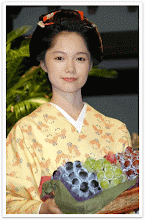
NHK Taiga Drama Go: Hime-Tachi no Sengoku shown here as Princess Go.
Go: Hime-Tachi no Sengoku (The Princess of the Warring States) tells
the story of a most remarkable outspoken princess named Oeyo or Ogo
who really lived during the height of the Sengoku Jidai – The
Warring States Period of Japan from 1573 to September 1626. The
series is narrated by Go-hime's mother Lady Ichi (Honami Suzuki) who
was the sister of the powerful warlord Oda Nobunaga (Etsushi
Toyokawa) who sent Lady Ichi to marry into the Azai Clan to marry
Azai Nagamasa to serve as Oda Nobunaga's eyes and ears.

But of course, just as our own everyday lives today in the Heisei Period, life then too had other plans.
Lady Ichi and Nagamasa fall in love and have two daughters born
Cha-Cha and Hatsu. But soon their idealyc life is disrupted by war.
The Azai are drawn into obligation to support the Asakura Clan whom
the Azai have had deep alliances with who are now at war with the
powerful Oda Clan. Having chosen to honor the Asakura, Nagamasa finds
himself under seige by the Oda's vassals the Toyotomi which during
this time Lady Ichi gives birth to Princess Go.
.jpg)

Go is born into this world during the
siege of Odami Castle. Her father Azai Nagamasa having defied Oda
Nobunaga is defeated by Oda's trusted general Toyotomi Hideyoshi
(Goro Kishitani) and sends Lady Ichi and her three daughters Cha-cha
(Miyazawa Rie), Hatsu (Mizukawa Asami), & infant Go whose lives
have been spared to go live with their uncle Oda Nobunaga. Princess
Go (Juri Uneo) will grow to be an outspoken princess who unlike her
older sisters bears no malice towards her uncle Oda Nobunaga who she
grew to admire and it is her Uncle Nobunaga himself who gives her his
advice “To only believe in yourself,” a motto she will grow to
live by.

Through her uncle Nobunaga, Go is given
access to some of the most powerful warlords of the Warring States
Period. But when her uncle Oda Nobunaga is betrayed by his vassal
Akechi Mistuhide (Masachika Ichimura) during the Honno-ji Incident in
1582, Go's world is uprooted once again by the man Oda Nobunaga named
“Saru” or monkey known as Toyotomi Hideyoshi because of his
monkey like mannerisms.
Under the rule of the Toyotomi, Lady
Ichi and her three daughters are sent away to marry Oda's trusted
rough looking yet stout General Katsui “Oni” Shibata (played by
Yasuo Daichi),” Life in Echigo is harsh in the cold winters of
Kitanoshō castle but in the short time Go learns to accept her new step
father.
.jpg)
As soon life became bearable, the
battle for who would succeed Oda Nobunaga places Shibata at war with
“Saru” Toyotomi Hideyoshi. Once again Lady Ichi and her three
daughters are trapped in a castle under siege by Toyotomi Hideyoshi,
the very man her uncle sent to destroy her father Nagamasa. And just
like before, the call to spare Lady Ichi and her three daughters is
given quarter. But having fallen in love with Shibata, Lady Ichi
refuses to go and instead chooses to make her last stand with her
second husband Shibata entrusting eldest daughter Cha-cha to take
care of her siblings and for middle daughter Hatsu to bring Go and
Cha-cha together. This was her final wish before Lady Ichi joined
Shibata in the burning confines of their castle and perished
together.
.jpg)
The loss of Lady Ichi devastates the
three sisters and disgusts them to be in “Saru's” care to whom
knowing he had lusted after Lady Ichi and now turned that lust to her
eldest daughter Cha-Cha to whom on her death Lady Ichi warns Saru not
to lay his hands on her. Of course, Saru ignores their sufferings and tries to buy
the three grieving sisters off with beautiful kimono and the luxuries only a
precious few outside of Kyoto would know at that time. While sister
Hatsu has easily accepted Saru's gifts of sweets and colorful new Kimono, Cha-Cha and Go resist. More
so Go's anger is unleashed on Saru who see's in her the face of his
angry Lord Nobunaga to whom he still feared even in death.
To rid himself of Nobunaga's ghost he
sends Go who is still a teenager to marry Saji Kazunari but the
marriage is short lived as Toyotomi changes his mind after 30 days
ordering her divorced and back to Osaka Castle.
Having endured much at the hands of
Saru, Go seeks the solace of the famed great tea master Rikyu a
favorite of Oda Nobunaga who is now forced to make tea for Hideyoshi
until death.
But as Toyotomi's schemes become more
despicable it becomes apparent to Go he has been getting help from
his trusted Toyotomi Vassal Ishida Mitsunari (played by Masato
Hagiwara) who plots against Rikyu who is later forced to commit
seppeku.
For this Go will never forgive Hideyoshi who plans to marry
her off again to his nephew Toyotomi Hidekatsu who oddly enough is a
match made in heaven. Anything to keep the ghost of Nobunaga at bay
so Saru can get his monkey paws on Cha-cha right?
Well after failing to attain the
position of Shogun, Toyotomi goes for the position of Regent in a
move to control Japan. Lustful intent for Cha-Cha and unlimited power
corrupts Hideyoshi to wage war in Korea and once again sends Go's
husband away causing her pain.
Hidekatsu fights a dreadful war in Korea and dies in there shortly after
Go gives birth to her daughter Sada. This is yet another instance that Go will hold Toyotomi Hideyoshi for. Meanwhile, Go's sister Hatsu has
fallen in love but can not marry without Saru's permission.
Hideyoshi's terms is to force Cha-Cha to become his concubine.
Still like that Toyotomi Hideyoshi? This is yet another unforgivable
attempt by Hideyoshi to destroy Go. Seeing Hatsu happy Cha-cha
sacrifices herself to become Lady Yodo and doing what her mother Lady Ichi objected to. Go becomes even more
infuriated with Hideyoshi who she still calls by her uncle Oda Nobunaga's demeaning moniker for Toyotomi Hideyoshi: Saru.
No matter what Saru does, he can not get past Go's anger and the memory of his old Lord who he still see's in her eyes. In a move to rid himself of this
problem, Hideyoshi arranges with Tokugawa Ieyasu for Go to marry his
son Hidetada (played by Osamu Mukai) who is six years her junior and
is heir to the Tokugawa family. An age difference that Hidetada is more than happy to remind her of.
But
before Go is to depart for Edo Mitsunari prompts Hideyoshi to order
Go's daughter Sada to stay behind at Osaka Castle because she is a
Toyotomi. This brings more hardship to Go at the hands of her parents
harbinger of death Toyotomi Hideyoshi is is now old and eccentricly
doting on his son with Lady Yodo Toyotomi Hideyori who Hideyoshi
instills as Regent and himself as Grand Regent. Remember these events
really did happen!
At
this point you can't wait for Toyotomi Hideyoshi to kick the bucket
and for his conniving henchmen and trusted Toyotomi Vassal Ishida Mitsunari to make a fatal
mistake and get what was coming to him. But not so fast! Old Saru had much chaos to inflict upon Lady Ichi's daughters before he left his life which will carry on way past his death to the battle of Sekigahara and through to the Seige of Osaka Castle that will seal the fate of his heir Hideyori and his mother Go's sister Lady Yodo with the destruction of the Toyotomi Clan!

Honestly, I don't how Princess Go survived all this! The ladies of the Warring States Period had to have been some tough women as such indicated by the advice of their mother Lady Ichi when she said "Women must fight their own battles." Meanwhile
in Edo Castle both Go and Hidetada face new challenges as they
both rise to prominence to survive the political positioning between
the powerful Regent Toyotomi Hideyoshi and the emerging power of
Ieyasu Tokugawa (Kitaoji Kin'ya) which is solidified after Toyotomi
Hideyoshi's death and culminated at the Battle of Sekigahara paving
the way for Ieyasu to become the future Shogun in this 2011 50
th
NHK Taiga Drama brilliantly written by Tabuchi Kumiko who brought you
Atsuhime.
.jpg)
Ok if you're not hooked by now there's nothing more I can do but say get your own copy and write your own review! Baka! - Just kidding. Of course we'd like to continue following American Mishima and continue to enjoy these riveting historical dramas from Japan. In America we like to say these aren't your grandma's soap operas but if you are lucky enough to have had an Obachan chances are these are just as good. As with all NHK Taiga Drama's you will
be both educated as well as entertained. It may even change your veiw on a few historical figures as this has with us concerning Lord Oda Nobunaga. If you have never seen a
Taiga Drama you will become addicted and want more. We can honestly say, Princess Go does not disappoint and has become one of our favorites which we believe will become yours too. Enjoy!
To get your own copy of Princess Go with English Subtitles


.jpg)

.jpg)


.jpg)
.jpg)
.jpg)

.jpg)
.jpg)

.jpg_thumb.jpg)
.jpg)

.jpg)
.jpg)

.jpg)

.jpg)


 And now to 2010's Hanjiro. The film is set in the Satsuma Domain 1862 present day Kagoshima, Japan. A lone upstart sweet potato farmer named Nakamura Hanjiro (brilliantly played by Tataaki Enoki) seeks an audience with the Satsuma Domain military Commander Saigo Takamori (played by Tanaka Seiji) to present him with the gift of sweet potatoes. With Saigo seated, Nakamura becomes intimidated as Okubo Toshimichi joins Takamori to see his skills he had obviously came to demonstrate to curry favor. Before Saigo can say anything a subordinate laughs at the notion of sweet potatoes which not only embarrasses the gracious host but offends Saigo to force him to apologize to Nakamura pointing out that sweet potatoes are hard to grow so best show some appreciation for this humble gesture. Humble or not, Nakamura's ulterior motive was indeed to be given the opportunity to demonstrate his sword skills in hopes that he could be made a Samurai. Impressed by both his skill and utter audacity, Saigo grants his wish and sends him to Kyoto to join other Satsuma Samurai in their quest to overthrow the Tokugawa Shogunate.


 Posts
Posts